

7 SaaS Performance Metrics That Drive Growth, Retention, and Scale
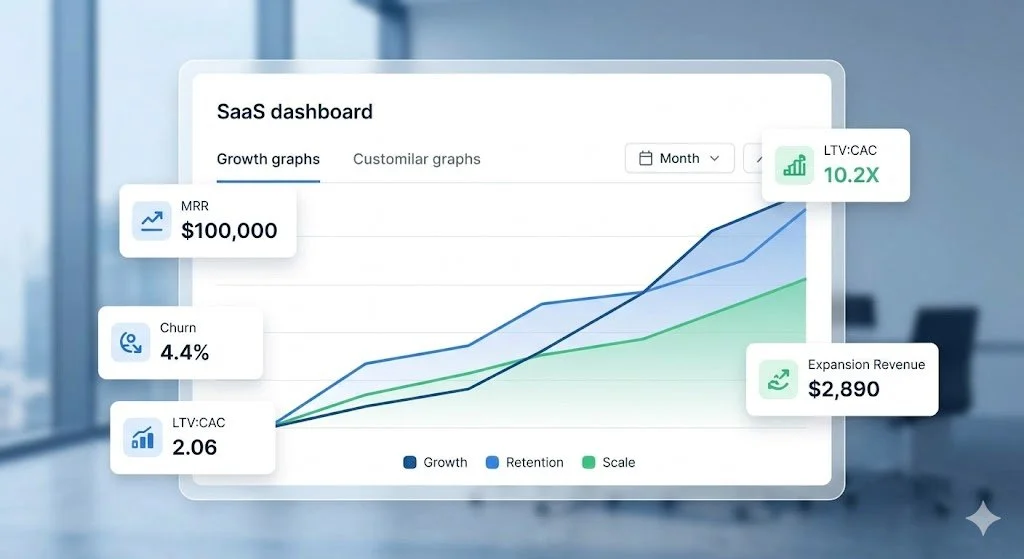
A small shift in a single metric — like pushing Net Revenue Retention (NRR) from 95% to 102% — can change how investors, founders, and product teams think about a SaaS business.
For founders and operators launching or scaling products, a clear grasp of saas performance metrics isn't optional; it's the operating manual for sustainable growth.
Why SaaS Performance Metrics Matter
Metrics turn guesses into decisions. For SaaS companies, especially startups and growing teams, the right set of performance indicators reveals whether product-market fit is real, where customers get value, which cohorts churn, and which acquisition channels produce profitable growth. These numbers guide prioritization — product work, pricing experiments, customer success efforts, or sales investments.
Founders at early-stage startups often obsess about signups or downloads. That’s fine for a week or two. But scaling beyond an MVP requires a disciplined metric framework that links acquisition, activation, retention, revenue, and support. That framework helps teams answer questions like: Are customers getting to value? How long before a new customer pays back acquisition costs? Which features reduce churn?
Core SaaS Performance Metrics: What to Track and Why
The following metrics are essential for nearly every SaaS business. Each metric includes a practical definition, the formula or calculation, and what it signals to a founder or operator.
Revenue Metrics
-
Monthly Recurring Revenue (MRR): The predictable monthly revenue from subscriptions.
Formula:
MRR = Σ (monthly price per customer). For annual contracts, divide by 12.Why it matters: MRR is the heartbeat of a SaaS business. Track new MRR (from new customers), expansion MRR (upsells), churned MRR (lost revenue), and net new MRR.
-
Annual Recurring Revenue (ARR): A yearlyized view of recurring revenue.
Formula:
ARR = MRR × 12(or sum of annual contract values).Why it matters: Useful for long-term forecasting, investor communication, and benchmarking against peers.
-
Average Revenue Per Account (ARPA/ARPU): Average revenue per customer over a period.
Formula:
ARPA = MRR / number_of_customers.Why it matters: Reveals pricing effectiveness and helps segment customers by value.
-
Net Revenue Retention (NRR): Revenue retention including upgrades and churn.
Formula:
NRR = (Starting MRR + Expansion MRR - Churned MRR - Contraction MRR) / Starting MRR× 100%Why it matters: NRR > 100% means existing customers are paying more over time — a core driver of scalable SaaS growth.
-
Gross Revenue Retention (GRR): Revenue retained excluding expansion.
Formula:
GRR = (Starting MRR - Churned MRR - Contraction MRR) / Starting MRR× 100%Why it matters: GRR focuses on how well a company avoids losing revenue from its base.
Customer Acquisition and Efficiency
-
Customer Acquisition Cost (CAC): How much it costs to win a customer.
Formula:
CAC = Sales & Marketing Expenses over period / Customers acquired in periodWhy it matters: CAC tells whether acquisition channels are sustainable, especially relative to customer lifetime value.
-
Lifetime Value (LTV or CLTV): The total revenue a customer is expected to bring during their relationship.
Simple formula:
LTV = ARPA × Gross Margin % / Customer Churn RateWhy it matters: LTV sets the ceiling for how much a company can pay to acquire customers profitably.
-
CAC Payback Period: Time to recover CAC.
Formula:
CAC Payback (months) = CAC / Monthly Gross Margin per CustomerWhy it matters: Shorter payback reduces cash needs and lowers risk during growth phases.
-
CAC:LTV Ratio: Balance of acquisition spend vs. customer value.
Rule of thumb: A ratio around
1:3is healthy for many SaaS businesses (i.e., LTV ≈ 3× CAC), but stage and margins matter.
Churn and Retention
-
Customer Churn Rate: Percentage of customers lost in a period.
Formula:
Customer Churn % = (Customers at start - Customers at end of period who remain) / Customers at startWhy it matters: Directly tied to growth. High churn forces ever-increasing acquisition to maintain MRR.
-
Revenue Churn Rate: Lost revenue percentage from existing customers.
Formula:
Revenue Churn % = Churned MRR / Starting MRRWhy it matters: Revenue churn captures value lost, which is particularly important for tiered pricing or enterprise customers.
-
Trial-to-Paid Conversion: Share of trial users who convert to paying customers.
Why it matters: Indicates product-market fit, onboarding effectiveness, and pricing alignment for freemium/trial models.
-
Time to Value (TTV): How long until a customer realizes meaningful value.
Why it matters: Shorter TTV generally reduces churn and improves conversion. TTV is often the product and onboarding team’s North Star.
Engagement and Product Health
-
DAU/MAU and Stickiness: Daily Active Users divided by Monthly Active Users; a measure of engagement frequency.
Why it matters: Higher stickiness typically correlates with lower churn and stronger product-market fit.
-
Feature Adoption: Percent of users using a feature.
Why it matters: Identifies what drives retention and expansion; product prioritization.
-
Cohort Retention: Retention by signup cohort over time.
Why it matters: Exposes whether improvements persist for new users or are limited to older cohorts.
Customer Success and Support Metrics
-
Net Promoter Score (NPS): Customer likelihood to recommend the product.
Why it matters: Predicts word-of-mouth growth and correlates with loyalty and expansion opportunities.
-
Customer Satisfaction (CSAT): Transactional satisfaction after interactions.
Why it matters: Useful to measure support quality and short-term customer sentiment.
-
First Response Time, Resolution Time, MTTR: Operational support KPIs.
Why it matters: Responsiveness affects churn and perceived value.
Operational and Reliability Metrics
-
Uptime / Availability: Percentage of time the service is available.
Common target:
99.9% (three nines)or higher, depending on SLAs. -
Latency and Error Rates: Response times and frequency of errors.
Why it matters: Performance problems directly impact user experience and retention.
-
Error Budget Burn Rate: How fast the allowable downtime is consumed.
Why it matters: Helps balance feature velocity with reliability.
Leading vs. Lagging Metrics: What to Monitor When
Not all metrics are created equal. Founders need both leading indicators (predictive, actionable) and lagging indicators (outcome measures). For example:
- Leading: Activation rate, TTV, onboarding completion, NPS trends — these signal future retention or expansion.
- Lagging: MRR, churn, ARR — these show results of past actions.
Early-stage startups should bias toward leading indicators to iterate quickly on product and onboarding. As the company scales, emphasis shifts toward lagging metrics for forecasting and capital planning, while still maintaining a strong handle on leading signals to drive continuous improvement.
How To Instrument Metrics Properly
Bad data produces bad decisions. Instrumentation is as important as choosing the metric itself. Here’s a practical checklist founders can use to ensure reliable tracking:
-
Define Events Precisely.
Example: "Account activated" must have a single definition (e.g., performed three core actions, uploaded data, and invited a teammate). Document this in a metric dictionary.
-
Use a Single Source of Truth.
Choose a primary metrics dataset — for many, this is the billing system for revenue metrics and an analytics tool for product events. Reconcile regularly.
-
Tag and Segment Early.
Track plan tier, acquisition channel, company size, region, and cohort at event capture. It's much harder to retrofit segmentation later.
-
Automate Data Validation.
Set alerts for sudden drops or spikes in MRR, signups, or key events. Small anomalies often indicate instrumentation breakage, not business change.
-
Retain Raw Event Data.
Aggregates are useful, but raw events allow deep cohort analysis and retroactive changes to definitions.
Common tooling includes Mixpanel or Amplitude for product analytics, Segment (or RudderStack) for event routing, ChartMogul / Baremetrics / ProfitWell for revenue analytics, and Looker/Tableau/Metabase for BI. CKI inc often helps clients design the instrumentation plan and choose the right toolset for their stage and budget.
Segmentation and Cohort Analysis: Where Real Insights Live
Aggregate metrics can hide important signals. Segmentation and cohort analysis make the difference between superficial reporting and actionable insight.
- Segment by Plan and ARR Bucket. Enterprise customers often behave differently than SMBs; churn is measured in dollars, not accounts.
- Segment by Acquisition Channel. Paid search, content, partnerships, and organic can produce wildly different LTVs and payback periods.
- Run Cohort Retention Tables. Compare cohorts week-by-week or month-by-month to see if changes to onboarding or pricing improve retention for new users.
- Follow Feature Cohorts. Identify cohorts that used a feature early and compare their expansion and churn to those who didn’t.
Example: A SaaS company observed a 6% lower churn rate for customers who completed an in-app workflow within the first 7 days. That insight directly informed prioritizing onboarding flows and in-app nudges — a classic case of a leading indicator driving a revenue outcome.
Benchmarks and Targets by Stage
Benchmarks vary by industry, pricing model, and customer size. Here are broad guidelines founders can use as starting points. Always adjust for company specifics.
- Early Stage (Pre-Product Market Fit): Focus on activation, trial conversion, and short TTV. Churn may be high; the goal is learning and improving retention curves.
- Growth Stage: Aim for NRR > 100% and CAC payback < 12 months. Focus on scaling acquisition channels with unit economics and closing product-market fit gaps.
- Scale / Expansion: Target NRR of 120%+, CAC:LTV near 1:3 or better, and payback under 12 months. Operational metrics like uptime and support SLAs become critical.
These aren't hard rules. For example, enterprise SaaS with long sales cycles might accept longer CAC payback and different CAC:LTV dynamics as long as ARR growth and gross margins justify it.
Turning Metrics into Action: Practical Playbook
Numbers themselves aren't the end goal. The value comes from using metrics to prioritize product changes, customer success plays, and GTM experiments.
1. Identify High-Leverage Metrics
Choose 1–3 metrics per team that most directly move revenue or retention. For product: activation rate or TTV. For CS: NRR or time-to-first-value. For marketing: CAC and trial conversion rate.
2. Create Hypotheses and Tests
Translate a metric into a hypothesis: "If onboarding completion increases by 10%, trial-to-paid conversion will rise 8%." Then design an A/B or cohort test and instrument it.
3. Short Feedback Loops
Run rapid experiments and measure leading signals weekly. For long-term metrics (like NRR), set monthly or quarterly checkpoints.
4. Use Health Scores for Accounts
Combine usage, support interactions, payment timeliness, and NPS into an account health score. Use it to prioritize outbound success outreach and identify expansion opportunities or churn risks early.
5. Align Incentives and Ownership
Assign metric owners — someone responsible for tracking, explaining, and proposing actions. Tie compensation or OKRs to these measurable outcomes so teams focus on moving the needle.
Common Pitfalls and How to Avoid Them
- Vanity Metrics: High signup growth with low activation means growth is shallow. Avoid celebrating surface-level numbers.
- Poor Instrumentation: Incorrect event definitions or duplicate events lead to mistrust. Invest early in clean tracking and a metric dictionary.
- Ignoring Segments: Treating all users as one pool hides differences between high-LTV and low-LTV cohorts.
- Not Connecting Product to Revenue: Product teams must understand how features influence NRR and churn so they can prioritize the right work.
- Delayed Responses to Signals: A small increase in trial drop-off may forecast big revenue loss months later. Build alerting and playbooks to act quickly.
Real-World Example: How CKI Inc Uses Metrics to Reduce Churn
CKI inc works with scaling SaaS companies to reduce churn and improve retention through an integrated approach: instrument → analyze → act. For one mid-market SaaS client, CKI performed the following:
- Instrumented product events and billing integration to create a single source of truth for MRR, feature usage, and support interactions.
- Built cohort retention dashboards segmented by plan, onboarding path, and acquisition channel.
- Discovered that customers acquired through a specific partner channel had decent initial conversion but poor 6–12 month retention due to missing onboarding steps.
- Launched targeted onboarding journeys and a concierge success path for the partner channel, reducing 6-month churn from 8% to 4% and lifting NRR from 95% to 106% within a year.
This example highlights how a focused measurement effort, paired with targeted CS and product interventions, drives revenue outcomes. The incubator also uses similar metric frameworks to help SaaS founders launch with clean instrumentation and metric-based roadmaps from day one.
Dashboards, Alerts, and Reporting Cadence
A practical reporting cadence keeps teams aligned without drowning them in numbers:
- Daily: High-level product health (errors, latency), MRR alerts for unusual churn/new MRR spikes.
- Weekly: Activation, trial conversion, funnel metrics, and top-of-funnel acquisition performance.
- Monthly: Detailed revenue breakdown (new, expansion, churn, contraction), LTV/CAC trends, cohort retention.
- Quarterly: Strategic levers — pricing experiments, ARPU shifts, large contract renewals, and roadmap impact analysis.
Set automated alerts for extreme deviations (for example, >10% drop in weekly activation rate or >5% monthly revenue churn spike). Designate on-call owners for critical alerts — often an operations or product lead.
Sample Calculation Walkthroughs
Two quick examples show how these metrics look in practice.
// Example 1: LTV and CAC
ARPA = $200 (monthly)
Gross Margin = 80%
Monthly Churn = 2%

LTV = ARPA * Gross Margin / Monthly Churn
LTV = 200 * 0.8 / 0.02 = $8,000

If CAC = $2,500, then CAC:LTV = 1:3.2
CAC Payback = CAC / (ARPA * Gross Margin) = 2500 / (200 * 0.8) = 15.6 months
// Example 2: NRR
Starting MRR = $100,000
Expansion MRR = $6,000
Churned MRR = $4,000
Contraction MRR = $1,000
NRR = (100000 + 6000 - 4000 - 1000) / 100000 = 1.01 = 101%These calculations show why small percentage improvements (reducing churn by 0.5% or increasing expansion) can have outsized effects on growth and valuation.
Advanced Metrics for Mature SaaS Companies
Mature stacks can benefit from deeper metrics and models:
- Unit Economics by Cohort and Channel: Model LTV and CAC for each cohort and acquisition source to optimize marketing spend.
- Customer-Level Lifetime Models: Use survival analysis and hazard models to predict churn risk per account.
- Propensity Models: Machine learning to predict expansion and churn for prioritizing success resources.
- Revenue Forecasting with ARIMA / Machine Learning: Blend historical seasonality with pipeline and leading indicators for more accurate ARR forecasts.
Not every founder needs sophisticated models from day one, but having a roadmap for advanced analytics helps align hiring (data engineers, data scientists) with business needs.
Final Checklist for Founders: Building a Metrics-Driven SaaS Company
- Define your North Star metric — a single metric that best captures customer value (e.g., NRR for expansion-focused businesses, activation for early products).
- Create a metric dictionary with definitions for each KPI.
- Instrument events and integrate billing as a single source of truth.
- Segment and run cohort analyses monthly.
- Set realistic targets per stage and review metrics with an owner-driven cadence.
- Use metrics to form hypotheses and run experiments with short feedback cycles.
- Invest in product reliability and support KPIs to protect revenue and reduce churn.
Conclusion
Understanding saas performance metrics is less about collecting endless dashboards and more about making insightful, repeatable decisions that improve retention, lower CAC, and increase LTV. For founders building or scaling a SaaS offering, the smartest move is to instrument early, focus on the few metrics that drive revenue, and iterate fast on leading indicators like activation and TTV.
CKI inc helps startups and scaling SaaS teams put this into practice — from designing instrumentation plans in the incubator to executing customer success programs for growth-stage companies. Using a data-first approach combined with customer-centric playbooks, CKI aims to reduce churn, accelerate payback, and help founders build durable, valuable SaaS businesses.
Frequently Asked Questions
Which single metric should a SaaS startup focus on first?
Early on, focus on a leading indicator that reflects customer value and activation — for many B2B SaaS startups, that’s either trial-to-paid conversion or Time to Value (TTV). These metrics reveal whether users reach a meaningful outcome, which is necessary before scaling acquisition.
How often should a SaaS company report metrics?
Operational health and critical alerts should be monitored daily. Teams should review activation and funnel metrics weekly, revenue and cohort retention monthly, and strategic KPIs like NRR and LTV quarterly. The cadence can vary by company stage.
What’s a healthy churn rate for SaaS?
It depends on customer size. For SMB-focused SaaS, monthly churn under 3% is common; for mid-market, under 1% monthly; and for enterprise, churn is usually lower but measured in dollars not accounts. Context matters — price point, contract length, and buyer type change expectations.
How should startups think about CAC vs. LTV?
Startups should ensure CAC is recoverable within a reasonable timeframe (often under 12 months) and that LTV is meaningfully higher than CAC (a common target is LTV ≈ 3× CAC). However, for enterprises with high expansion potential, longer payback periods can still be acceptable.
Which tools are best for tracking saas performance metrics?
Common stacks include Segment (event routing) + Mixpanel or Amplitude (product analytics) + ChartMogul/Baremetrics/ProfitWell (revenue analytics) + Looker/Metabase/Tableau for BI. The best combination depends on team size, budget, and the complexity of analysis required.
Get A Free 30-Minute Strategy Session
Fill out the questionnaire to receive a personalized growth plan based on your current stage, from startup to enterprise, through a free consulting session with one of our executives.
Get Started ➜Related Articles








A SaaS startup cut its customer acquisition cost by half and doubled its monthly recurring revenue within nine months by rethinking who it targeted, simplifying onboarding, and turning existing users into vocal advocates.