

How To Find & Diagnose Churn Causes: A Complete Guide for SaaS SMBs
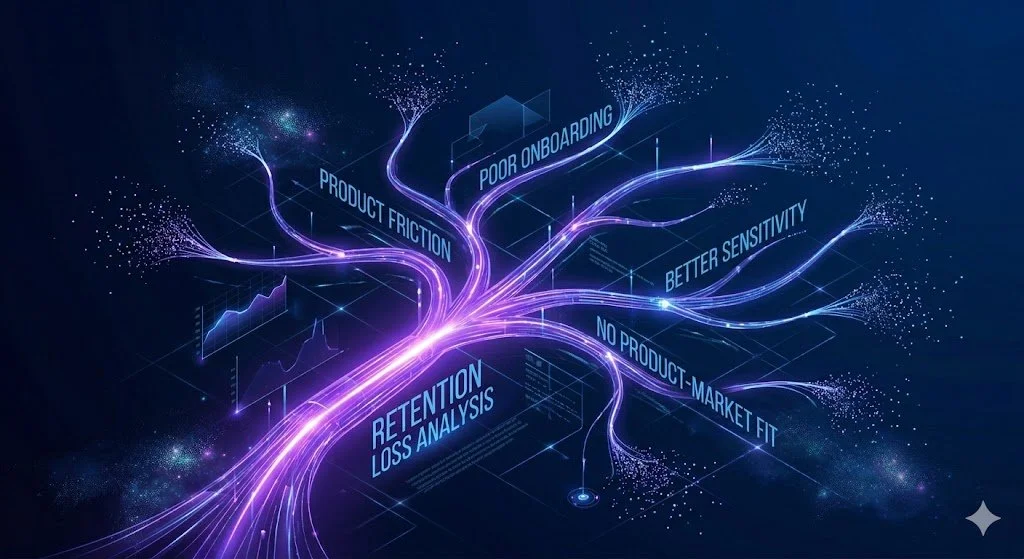
A small change in churn can make or break a SaaS startup.
For founders focused on growth, understanding churn causes is not an academic exercise — it's the difference between a scalable, profitable business and a leaky bucket that never fills.
This article walks through the most common drivers of churn, how to diagnose root causes, and practical strategies SaaS teams can use to stop customer leakage and increase lifetime value.
Why Churn Deserves Top Priority
SaaS economics rely on customer retention. When customers stay longer, lifetime value (LTV) rises, CAC payback improves, and unit economics become attractive to investors. Conversely, high churn forces constant new-customer acquisition, inflating marketing spend and masking product weaknesses.
For early-stage startups and scaling SaaS businesses alike, a 1–2% monthly decrease in churn can translate into substantial revenue gains over a few years. That's why founders and growth teams treat retention as a growth lever on par with acquisition.
What Churn Means (Quick Definitions)
- Churn rate: The percentage of customers or revenue lost in a given period. Basic formula for customer churn:
Churn Rate = Customers Lost During Period / Customers at Period Start. - Logo churn: The count of customers who cancel.
- Revenue churn: The percentage of recurring revenue lost (MRR/ARR churn), sometimes offset by expansions.
- Gross vs. Net Churn: Gross churn ignores expansions; net churn accounts for upgrades and expansion revenue.
Common Churn Causes (And How To Spot Them)
Churn rarely comes out of nowhere. It’s usually the end result of multiple frictions — some obvious, some buried in product telemetry or customer conversations. Below are the most common causes and how a SaaS team can detect them early.
1. Poor Product–Market Fit
When customers churn because the product simply doesn't solve a meaningful problem, every other effort becomes a band-aid. Signs include low initial engagement, short trial-to-paid conversions, and a high proportion of users that never reach basic activation events.
How to spot it:
- High drop-off in the first 7–30 days.
- Low feature adoption across cohorts.
- Qualitative feedback that the product is “nice” but not essential.
How to remediate:
- Revisit the value hypothesis via customer interviews and jobs-to-be-done research.
- Run experiments on positioning, onboarding, and core flows to increase time-to-value.
- In CKI’s incubator work, teams rapidly test MVP pivots to validate fit before scaling marketing spend.
2. Slow or Confusing Onboarding (Time to Value)
Customers churn when they fail to see value fast enough. Onboarding should create a predictable path to a “wow” moment within days, not weeks.
How to spot it:
- Low completion rates for onboarding sequences.
- Users who sign up but don’t trigger core value events (e.g., first report run, first team invite).
- Support tickets asking “How do I…?” within the first week.
How to remediate:
- Map the activation funnel and reduce friction points — cut required fields, auto-skip steps that block value.
- Use interactive guides, contextual help, and milestone email sequences.
- Pair self-serve flows with targeted success outreach for higher-tier customers; CKI builds playbooks that mix automation and human touch to scale onboarding effectively.
3. Poor Product Usability or Reliability
Bugs, crashes, slow load times, and confusing UI lead to frustration and cancellation. Often, engineering metrics reveal this before customers complain.
How to spot it:
- Spike in error logs or page-load times correlated with churn cohorts.
- Frequent support tickets about basic functionality.
- Repeated complaints in NPS or in-app feedback about stability and UX.
How to remediate:
- Prioritize reliability fixes and neat UX polish over “nice-to-have” features during critical growth phases.
- Communicate transparently about outages and timelines; trust erodes fastest when customers feel ignored.
- Instrument performance monitoring and tie SLOs (service-level objectives) to customer SLAs.
4. Misaligned Pricing and Packaging
When pricing doesn’t match the perceived value or use case, customers either downgrade or leave. Common patterns: pricing too complex, too expensive for the realized value, or misaligned tiers that force customers into ill-fitting plans.
How to spot it:
- Customers frequently ping sales for custom quotes or downgrade shortly after upgrade.
- Low conversion on premium features; high usage of base features only.
How to remediate:
- Test simple pricing experiments: value-based tiers, usage-based pricing, or freemium-to-paid funnels.
- Collect willingness-to-pay data and map it to customer segments. CKI’s pricing work uses experiments to find the best packaging without alienating current users.
- Introduce add-ons or modular pricing for customers whose needs grow in predictable ways.
5. Competition and Better Alternatives
Sometimes churn is caused by competitors offering better features, price, or integrated ecosystems. This is especially common in crowded categories.
How to spot it:
- Exit interviews that mention switching to a competitor.
- Customers canceling after competitor launches or promotions.
How to remediate:
- Differentiate product through unique workflows, integrations, or specialized vertical features.
- Invest in customer success relationships to make switching costs nontrivial.
- Monitor competitors, but prioritize user-validated differentiation over chasing every competitor feature.
6. Billing Failures and Payment Friction
Simple billing issues — expired cards, invoices lost in spam, or confusing billing periods — are a massive source of involuntary churn.
How to spot it:
- High involuntary churn rate (failed payments leading to cancellations).
- Many dunning-related support contacts.
How to remediate:
- Implement smart dunning: multi-channel reminders, card update tools, and retry logic.
- Offer flexible billing cycles and clear invoices.
- Use payment providers with built-in recovery tools and card updater features.
7. Lack of Customer Success and Support
Even a great product loses customers if they feel unsupported. Customer success is proactive — it helps customers realize value continuously, not only when they ask for help.
How to spot it:
- Customers repeatedly ask for best practices that suggest they aren’t using the product effectively.
- Lower NPS among customers who had no success manager.
How to remediate:
- Create scalable success programs: onboarding journeys, playbooks per segment, and periodic value-checks.
- Use health scoring to triage outreach and identify at-risk accounts early.
- Train onboarding specialists and set clear escalation paths to product and engineering.
8. Organizational Changes at the Customer
Customer churn sometimes has nothing to do with the product: layoffs, role changes, or budget cuts can force cancellations. These are often categorized as “customer-driven” churn.
How to spot it:
- Accounts with declining user seats or fewer logins overall.
- Contract non-renewals during known economic downturns.
How to remediate:
- Offer flexible plans and options to pause instead of canceling entirely.
- Keep relationships warm: continued value communication can bring customers back later.
- Track macroeconomic indicators and build flexible commercial responses for sales teams.
A Practical Framework for Diagnosing Churn
Diagnosing churn is a combination of data analysis and human conversations. A reliable process follows common-sense steps and repeatable analysis.
Step 1: Define What to Measure
Decide whether the team measures customer churn (logos), revenue churn (MRR/ARR), or both. Early-stage startups often watch logos; later stages must optimize revenue churn because expansions, downgrades, and reactivation matter more.
Example formulas:
- Customer churn rate (monthly):
Churn = Customers Lost / Customers at Start of Month - MRR churn rate (monthly):
MRR Churn = (MRR Lost to Churn - MRR Expansion) / MRR at Start
Step 2: Segment Your Data
Segment churn by cohort (signup month), plan type, industry, company size, acquisition channel, and product usage. Segments reveal where churn clusters.
- Example: If enterprise plans show lower churn than SMB, but SMB drives 70% of signups, retention efforts should target SMB-specific onboarding.
Step 3: Cohort and Funnel Analysis
Track cohorts over time to see retention curves. A classic visualization is a cohort retention table: what percent of users from each month remain active in month 1, 2, 3, etc. This shows whether churn is front-loaded (onboarding problem) or long-term (product value or competition).
Step 4: Root Cause via Mix of Qual and Quant
Numbers point the way, but conversations confirm why. Combine:
- Support tickets and call logs
- Exit and renewal surveys
- Customer interviews (structured, with hypothesis testing)
- Product analytics (feature usage, session length, depth of use)
Use techniques like the 5 Whys in a cross-functional workshop to trace churn incidents back to process or product issues.
Step 5: Prioritize Fixes with Impact × Effort
Not all churn contributors are equally fixable. Build a prioritized roadmap of experiments and fixes based on estimated impact and implementation effort. Start with high-impact, low-effort items (billing fixes, onboarding copy changes) then tackle platform improvements.
Example Diagnostic: Calculating the Impact of Onboarding Friction
Suppose a SaaS with 2,000 customers sees 6% monthly logo churn. Cohort analysis reveals 60% of cancellations happen within the first 30 days. If the team can reduce early churn by half, what happens?
- Original monthly churn = 6%.
- Early churn (first 30 days) = 0.6 * 6% = 3.6%.
- Reducing early churn by 50% saves 1.8% churn overall.
- New monthly churn = 6% - 1.8% = 4.2%. Over a year, this difference compounds and significantly increases retained customers and revenue.
Concrete math like this helps prioritize projects: a targeted onboarding rebuild may be far more valuable than a new feature that marginally increases engagement.
Actionable Strategies to Reduce Churn
Once causes are understood, a combination of product, process, and people changes can reduce churn. Below are practical, tested strategies proven in scaling SaaS companies.
Improve Onboarding and Activation
- Make the first meaningful action obvious and easy to complete.
- Use progressive disclosure: show what’s necessary now and hide advanced options until needed.
- Provide templates or starter kits so new customers can get results with minimal setup time.
- Combine automated in-app guidance with human outreach for high-value accounts.
Strengthen Customer Success
- Implement health scores using product usage, login frequency, support interactions, and billing signals.
- Create tiered success models: automated touchpoints for self-serve, named CSMs for mid-market, and account teams for enterprise.
- Design renewal and expansion playbooks that trigger at predictable points in the lifecycle.
Make the Product Sticky
- Build engagement loops tied to core outcomes: notifications, integrations, collaborative features that grow with team usage.
- Focus on data portability and integrations that embed the product in customers’ workflows (reducing switching friction).
Optimize Pricing and Packaging
- Experiment with tier value drivers — seat counts, features, data volume, support level.
- Consider usage-based pricing for highly variable customers to align cost with value.
- Offer pre-renewal check-ins and usage reviews to justify price and surface expansion opportunities.
Address Technical and Reliability Issues Promptly
- Prioritize SRE and incident response for customer-impacting issues.
- Communicate outages clearly and give remediation timelines and compensation where appropriate.
- Use feature flagging and gradual rollouts to reduce production surprises.
Fix Billing and Reduce Involuntary Churn
- Set up multi-step dunning sequences, email + SMS reminders, and easy card-update flows.
- Show billing status in the product UI to reduce confusion.
- Offer short-term pauses or flexible plans if customers face budget constraints rather than complete cancellations.
Win-Back and Reactivation Programs
- Segment churned customers by reason and build targeted win-back campaigns (product updates, discounted trials, new features).
- Measure reactivation rate and the quality (LTV) of reactivated customers versus new ones.
Quick Wins vs. Long-Term Investments
Founders should balance fast, low-cost fixes with deeper product investments.
- Quick wins: smart dunning, targeted email onboarding flows, clearer pricing pages, and a short list of UX fixes identified via heatmaps.
- Long-term investments: refactoring core architecture to improve reliability, launching major integrations, rethinking pricing strategy, and building out a full Customer Success organization.
Using Predictive Models to Anticipate Churn
Predictive analytics can flag at-risk customers before they cancel. Typical models use features like login frequency, feature usage, support tickets, NPS scores, and billing health to predict churn probability.
Key considerations:
- Start simple: logistic regression with interpretable features often beats complex black-box models for actionability.
- Ensure data quality: bad labels (mis-attributed churn reasons) produce poor models.
- Focus on the action: the model is useful only if it triggers an effective intervention (e.g., a tailored success outreach).
CKI helps clients build pragmatic churn models combined with automated playbooks so data-driven signals lead to real retention actions rather than alerts that go unanswered.
Measuring Progress and Building a Retention Culture
Reducing churn is an ongoing discipline requiring cross-functional ownership. Product, marketing, sales, engineering, and customer success must align around the same retention metrics.
KPIs to Track
- Monthly and annual logo churn
- MRR/ARR gross and net churn
- Retention cohorts (30/90/180-day retention)
- Time to first value (TTV)
- NPS/CSAT and product usage frequency
Make retention part of OKRs and compensation: teams that own churn outcomes are more likely to prioritize the right experiments and fixes.
Feedback Loops
Create tight loops from support and success into product development. Regular “customer insight” meetings where engineers hear customer pain directly can accelerate fixes that reduce churn.
Real-World Examples
Example 1 — Onboarding Revamp
- A mid-market SaaS noticed 45% of churn occurred in the first 60 days. They redesigned onboarding to focus on a single activation metric and added a one-week human check-in for high-value accounts. Within six months, early churn dropped 30% and net retention improved by 8 percentage points.
Example 2 — Billing Recovery Program
- An SMB-focused product was losing customers to failed card payments. Implementing a two-week dunning flow with in-app card update and a one-click retry reduced involuntary churn by 60% and increased recovered MRR substantially.
Example 3 — Pricing Alignment
- A team discovered that customers were downgrading because they only used a single feature, yet paid for a suite. After launching a lower-priced single-feature tier and usage-based overage pricing, churn for small accounts dropped and average revenue per user increased for those who expanded.
CKI’s growth work often blends these tactics: identifying quick wins for immediate retention uplift while building longer-term product and pricing strategies that lock in value and reduce churn structurally.
Common Pitfalls Founders Should Avoid
- Chasing vanity metrics (e.g., signups) without matching retention metrics.
- Over-segmenting experiments so each has too little data to reach conclusions.
- Implementing technical solutions for fundamentally product-market-fit problems.
- Failing to operationalize insights — detecting churn causes is only useful if it leads to prioritized actions.
Conclusion
Understanding churn causes is a practical, high-impact discipline for SaaS founders. By combining solid measurement, targeted segmentation, customer conversations, and prioritized experiments, startups can transform churn from a recurring drain into a controlled lever for growth. Quick fixes like better dunning or clearer onboarding can yield immediate gains, while investments in core product value and customer success build durable retention advantages.
CKI Inc works with SaaS teams at both ends of the spectrum — launching startups in its incubator where early retention experiments are baked into MVPs, and helping scaling companies build customer success engines and pricing strategies that reduce churn. For founders aiming to scale effectively, treating churn as a design challenge — not an inevitability — is the fastest route to sustainable ARR and stronger unit economics.
Frequently Asked Questions
What is an acceptable churn rate for a SaaS company?
It depends on the stage and customer segment. For enterprise SaaS, monthly churn can be well under 1%, while SMB-focused products often see higher churn (2–8% monthly). The key is improving retention over time and aligning churn targets with growth goals and unit economics.
Should a startup focus on logo churn or revenue churn first?
Early-stage startups typically optimize for logo churn (customer count) to validate product-market fit. As the business scales, revenue churn becomes more critical because expansions and downgrades materially affect ARR and growth sustainability.
How quickly can churn be improved?
Some improvements (billing fixes, onboarding emails) can show results in weeks. Structural changes (pricing redesign, major product refactors) may take months. The recommended approach is to combine quick wins for immediate relief with longer-term investments for durable improvement.
Can churn be predicted reliably?
Yes, to an extent. Predictive models using behavioral, billing, and support signals can identify at-risk accounts with useful accuracy. The value of models is highest when they're coupled with automated or human interventions that address identified risks.
How often should a team revisit churn analysis?
Monthly monitoring is common for MRR and logo churn, with deeper cohort analyses quarterly. After significant product, pricing, or go-to-market changes, teams should run fresh diagnostic analyses to capture new churn dynamics.
Get A Free 30-Minute Strategy Session
Fill out the questionnaire to receive a personalized growth plan based on your current stage, from startup to enterprise, through a free consulting session with one of our executives.
Get Started ➜Related Articles







Product-Led Growth isn't just a strategy for acquisition; it is the fundamental engine for lifecycle expansion. Founders who obsess over PLG beyond the initial sale understand a critical truth: your product itself must create and capture new value.