

5 MVP Launch Strategies: How to Validate, Build, and Scale Your SaaS Product
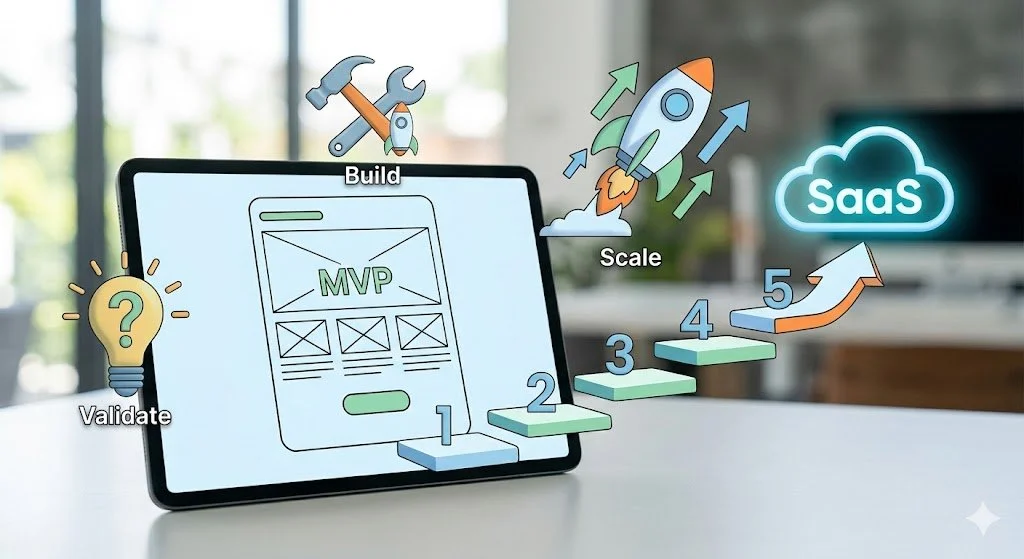
Effective MVP launch strategies do more than get a product into users' hands quickly.
They shape the future of a business. For SaaS founders, an MVP is a tool for learning, not just a stripped-down version of a product.
This article walks through proven approaches to validate ideas, design a lean yet valuable minimum viable product, plan a launch that attracts the right early adopters, and iterate toward growth while keeping churn low.
Why MVP Launch Strategies Matter
Many startups treat an MVP like a checklist item: build something fast, ship, then scale. That mindset creates expensive mistakes. The best MVP launch strategies center on rapid learning: discovering whether paying customers care about the problem, identifying the smallest set of features that deliver value, and testing assumptions about pricing and retention before scaling acquisition.
For SaaS founders, the stakes are higher: recurring revenue depends on retention, and poor onboarding or misaligned value leads to churn. A launch strategy that pairs product experiments with customer success and growth tactics helps a startup move from fragile early traction to sustainable units of growth.
Understand the Goal: What Is an MVP, Really?
An MVP (minimum viable product) is the simplest product that allows a team to validate the riskiest assumptions behind a business idea. Those assumptions often include:
- Customers recognize the problem and want a solution.
- They’ll pay for the solution at a price that sustains the business.
- They’ll continue using the product over time (retention).
When founders frame their MVP around testing these assumptions, every design, marketing, and support decision becomes a deliberate experiment. The objective is to learn quickly with the least waste of time and capital.
Pre-Launch Work: Discover, Validate, and Prioritize
1. Customer Discovery That Actually Helps
Start with conversations — not feature lists. Talk to prospective users where they already are: relevant forums, Slack groups, LinkedIn communities, or existing customer bases if pivoting. Use open-ended questions to uncover pain points, consequences of ignoring the problem, and current workarounds.
Practical tip: aim for 30 qualitative interviews before building. Patterns generally emerge by interview 20–30, and outliers become clearer.
2. Define the Hypotheses You Want to Test
Turn insights into testable hypotheses. Examples:
- "SMB financial teams will pay $50/month for automated invoice reconciliation because it saves them at least 2 hours per week."
- "Freemium users who complete onboarding 3 days in a row have a 2x higher 90-day retention."
Each hypothesis maps to metrics you’ll watch during the MVP launch: activation, conversion, retention, churn, and early revenue.
3. Prioritize Features with the North Star in Mind
Use frameworks like RICE (Reach, Impact, Confidence, Effort) or MoSCoW (Must-have, Should-have, Could-have, Won't-have) to prioritize. The MVP must deliver the core job-to-be-done — not a feature checklist for an idealized user.
Designing the MVP: Scope, UX, and Tech Choices
Keep the Scope Razor-Sharp
The MVP should solve one primary job exceptionally well. Resist the temptation to include features that are "nice to have" for a broader user base. That’s how feature bloat happens before product-market fit.
Map a Lean User Journey
Design a friction-minimized path for new users to experience core value quickly — typically within minutes or a single session. For SaaS, that often means an onboarding flow that highlights a single "aha" moment: first report generated, first automation completed, first team invited.
Choose the Right Tech Stack — Fast and Flexible Wins
For MVPs, prefer composability and speed over micro-optimization. Options include:
- No-code/low-code tools (Bubble, Webflow, Zapier, Airtable) for simple UIs and workflows.
- Backend-as-a-service (Firebase, Supabase) for authentication and data.
- Minimal backend frameworks (Express, FastAPI, Rails) if custom logic is required.
Engineering leaders should weigh time-to-learn for the team, cost, and the ability to pivot. Building a monolithic, complex architecture for an unproven idea wastes runway.
Launch Modes: Choose How to Release Your MVP
Different MVP launch strategies serve different goals. Here are the most effective modes and when to use them.
1. Landing Page + Waitlist
Use when testing market demand and pricing before building. A simple landing page with benefits, mockups, pricing options, and a call-to-action to join a waitlist provides quick validation. Drive traffic via content, ads, and partnerships, and measure click-through and sign-up conversion rates.
2. Wizard or Concierge MVP
A concierge MVP replaces software with manual services to test demand and refine solutions. It's excellent for high-touch, complex tools where workflows matter as much as features. The team manually fulfills tasks, learning customer needs before automating them.
3. Beta Releases (Closed or Public)
Closed beta focuses on a controlled group of early adopters — often with NDAs and feedback sessions. Public beta opens to a broader audience. Use betas to test product stability, collect feature requests, and establish early relationships with advocates.
4. Product-Led Growth (PLG) MVP
A PLG approach centers on self-serve onboarding, viral hooks, and product-embedded acquisition. If the product naturally encourages sharing or team invites, a PLG MVP should prioritize the invite flows, usage virality, and clear value in the first user session.
5. Integrations-First Launch
For many SaaS products, integration with existing tools can be the primary adoption lever. Launch an MVP with 1–2 strategic integrations (Slack, Google Workspace, Salesforce) to provide immediate utility and lower adoption friction.
Acquisition and Messaging: Attract the Right Early Adopters
Craft Messaging That Speaks to a Specific Job-To-Be-Done
Generic positioning confuses early users. Use headline messages that capture the core benefit in one line and subheads that explain outcomes (time saved, errors eliminated, revenue increase). For instance: "Automate invoice reconciliations — cut processing time by 70%." That’s clearer than "intelligent finance platform."
Channels That Work for MVPs
- Content and SEO: Long-term, but useful for founders who already have domain expertise and networks.
- Community Outreach: Niche Slack/Discord channels, Reddit, and industry forums yield targeted leads.
- Partnerships: Integrations or co-marketing with complementary tools accelerate credibility.
- Paid Ads: Useful for testing conversion at scale, but track CAC carefully for early-stage products.
- Direct Outreach: Founder-led outreach on LinkedIn or email often converts well for B2B MVPs.
Offerings for Early Adopters
Incentivize early users with time-limited discounts, lifetime pricing, or personalized onboarding. Be transparent about what early adopters will get — and what they should expect (bugs, active product development, feature prioritization).
Pricing Experiments as Part of MVP Launch Strategies
Pricing is a hypothesis. Approach it like an experiment:
- Start with simple tiers: free trial, one paid tier, and an enterprise option.
- Test price points using landing pages, pricing A/B tests, and direct conversations with prospects.
- Measure willingness-to-pay signals: sign-ups, paid conversions, and negotiation frequency for the enterprise tier.
For SaaS, even small changes in price can dramatically alter LTV and customer perception. Track metrics like conversion rate from trial to paid, average revenue per user (ARPU), and churn across pricing segments.
Onboarding, Customer Success, and Churn Prevention from Day One
Retention is a product metric and a team responsibility — not just a support ticket queue. Integrate customer success into your MVP launch strategy before users complain.
Design an Onboarding Flow That Delivers the "Aha" Moment
Identify the single action or outcome that proves value and guide new users toward it with contextual tips, checklists, and short tooltips. Every step should either increase confidence or move the user toward activation.
Early Customer Success Practices for MVPs
- High-touch onboarding for early customers: personalized demos or setup calls.
- Weekly feedback sessions or surveys during the first 60–90 days.
- Use in-app messaging for proactive help — users often appreciate quick nudges more than long help articles.
CKI inc emphasizes customer success as a growth lever. In its work with scaling SaaS clients, CKI pairs early adopters with CS specialists who translate feedback into product priorities and reduce early churn by ensuring initial value is realized.
Measurement: What to Track During and After the Launch
Pick a small set of metrics tied to your hypotheses. Typical metrics for MVP launch strategies include:
- Activation: percent of users who hit the "aha" moment.
- Trial-to-paid conversion: percent who convert within a set time window.
- Retention cohorts: short-term retention (7/30/90-day) and long-term patterns.
- Churn rate: monthly churn and reasons for cancellation.
- CAC and LTV: acquisition efficiency and expected lifetime value.
- Net Promoter Score (NPS): a qualitative measure of satisfaction and referral potential.
Use simple dashboards to keep these metrics visible to the team. The goal is to make decisions driven by real user behavior, not anecdote.
Iterate Fast: From Feedback to Feature Priorities
An effective MVP launch strategy treats every user as a source of learning. Create a feedback loop:
- Collect qualitative feedback in interviews and quantitative signals in analytics.
- Translate feedback into hypotheses (e.g., "Users cancel because onboarding misses step X").
- Design small experiments to test fixes (copy changes, UI tweaks, onboarding flows).
- Ship, measure, and repeat.
Use feature flags and canary releases to limit blast radius. Small, frequent releases reduce risk and accelerate learning.
When to Scale: Signs Your MVP Is Ready
Founders often ask, "How many users or how much revenue before scaling?" The answer depends on unit economics and retention. Signs an MVP is ready to scale:
- Consistent MRR growth with healthy conversion rates from free/trial to paid.
- Retention improves across cohorts — early users stay beyond the free trial.
- Unit economics are favorable: LTV significantly exceeds CAC with a payback period that fits the business model.
- Product ops are repeatable: onboarding, support, and sales processes are documented and can be handed off.
Scaling prematurely magnifies weaknesses — poor onboarding, high churn, or unstable architecture. Address these before increasing spend on acquisition.
Common MVP Launch Mistakes and How to Avoid Them
Mistake 1: Building Features for "Everyone"
Don't design for the mythical average user. Niche targeting helps early adoption and creates specific messaging that resonates. Define an ICP (ideal customer profile) and tune the product to solve that group's job-to-be-done exceptionally well.
Mistake 2: Ignoring Onboarding and Support
Even the most elegant product needs a good first experience. Track activation closely and invest in onboarding flows or human support for the first cohort. That investment pays off in lower churn.
Mistake 3: Over-Engineering the Tech Stack
Early-stage products benefit from pragmatic choices. Use third-party services for non-differentiating parts (payment, authentication, email). Save engineering effort for unique, value-driving features.
Mistake 4: Measuring the Wrong Things
Vanity metrics like total sign-ups don't indicate health. Focus on activation, retention, and revenue per cohort to understand whether the product provides sustained value.
Practical Examples: MVP Launch Strategies in Action
Example 1: Landing Page to Paid Conversions
A startup targeting indie developers built a simple landing page highlighting a time-saving automation for CI/CD pipelines. The page included two price points and a demo video. With targeted Reddit ads and a developer-focused newsletter, the team tested conversion rates. They found a 5% conversion from visitor to sign-up and a 10% trial-to-paid conversion at $15/month — enough to justify building a more complete product and integrating with GitHub.
Example 2: Concierge MVP for a B2B Workflow Tool
A team hypothesized small agencies would pay for a tool that automates client reporting. Instead of building the whole product, the founders manually generated reports from supplied data and charged $199 for a monthly service. The exercise validated willingness to pay, identified core report elements, and highlighted necessary integrations. The next phase automated the top 30% of the workflow — the part customers valued most.
CKI inc's Incubator Approach
CKI inc runs an incubator for SaaS startups combining product development, customer success, and growth strategies. Its teams often start with customer discovery and concierge MVPs, then move to minimal self-serve products while pairing early customers with CS specialists. This approach reduces churn early on and informs roadmap decisions with real customer outcomes, accelerating product-market fit.
Checklist: A Launch-Ready MVP
- Clear hypothesis about the customer problem and willingness to pay.
- Defined ICP and targeted messaging for that group.
- Prioritized feature set focused on the "aha" moment.
- Lean tech stack with fast paths to iterate.
- At least 20–30 pre-launch customer discovery interviews.
- Measurement plan: activation, retention, conversion, churn, CAC, LTV.
- Onboarding and CS plan for the first cohort.
- Pricing experiments and landing pages ready.
- Feedback loop and roadmap prioritization process.
Scaling Beyond the MVP
Once the MVP proves core assumptions, shift focus to repeatability and scale:
- Automate onboarding and embed product analytics to maintain visibility into activation.
- Harden the architecture for reliability and performance.
- Expand integrations that reduce friction for larger customers.
- Develop a sales motion for mid-market or enterprise buyers if warranted.
- Invest in customer success teams that reduce churn and expand accounts through upsell.
For startups working with CKI inc, this phase often includes structured growth programs: optimizing acquisition channels, refining pricing tiers for LTV maximization, and establishing customer success playbooks that scale without sacrificing the early-company touch.
Mindset: Treat Your Launch as an Ongoing Experiment
MVP launch strategies are not a one-time checklist — they’re a mindset. Founders who succeed embrace continuous experimentation, shipping small changes, measuring impact, and listening to customers. The MVP is the start of a learning machine that, over time, shapes product decisions and drives sustainable growth.
Frequently Asked Questions
What’s the difference between an MVP and a prototype?
An MVP is a functional product aimed at learning about users and validating business assumptions with real usage, often including paid transactions. A prototype is usually a non-functional or semi-functional mock designed to test user flows or gather design feedback without full backend functionality.
How many features should an MVP have?
There's no magic number. The right approach is to include only the features required for users to reach the core value or "aha" moment. Focus on the job-to-be-done and remove anything that doesn't directly contribute to demonstrating value.
When should a founder move from high-touch onboarding to automated onboarding?
Move when onboarding processes are repeatable and metrics show consistent activation without one-on-one help. High-touch is valuable for early validation and deep learning; automation scales those learnings into a reliable experience for more users.
Is it okay to use no-code tools for an MVP?
Yes. No-code and low-code tools accelerate time-to-market, enable rapid iteration, and are often the right choice when the product’s value isn't tied to complex infrastructure. Transition to custom code only when scaling requires performance, custom integrations, or unique security needs.
How should pricing be pitched to early adopters?
Be honest: communicate that early adopters help shape the product and will receive perks like discounted pricing, direct access to the founding team, or extended trials. Use early conversations to test willingness-to-pay and feature willingness, and document objections to guide future pricing.
Conclusion
Strong MVP launch strategies balance speed with discipline. They start with customer discovery, build the smallest product that proves value, and use early adopters to refine positioning, pricing, and product-market fit. For SaaS founders, pairing product experiments with customer success and measurable growth tactics is essential to reduce churn and build a profitable recurring-revenue engine.
CKI inc’s work with both scaling SaaS companies and new incubator startups illustrates the power of integrating customer success early into product strategy. Whether a team chooses a landing page waitlist, a concierge MVP, or a product-led public beta, the most successful launches are those that learn fast, iterate often, and keep customers’ outcomes front and center.
Founders who approach their MVP as a structured set of experiments — with clear hypotheses, metrics, and a bias toward action — will make smarter decisions and increase their chances of turning an idea into a scalable SaaS business.
Get A Free 30-Minute Strategy Session
Fill out the questionnaire to receive a personalized growth plan based on your current stage, from startup to enterprise, through a free consulting session with one of our executives.
Get Started ➜Related articles








Product-Led Growth isn't just a strategy for acquisition; it is the fundamental engine for lifecycle expansion. Founders who obsess over PLG beyond the initial sale understand a critical truth: your product itself must create and capture new value.