

5 Churn Reduction Frameworks: Practical Strategies for SaaS Growth
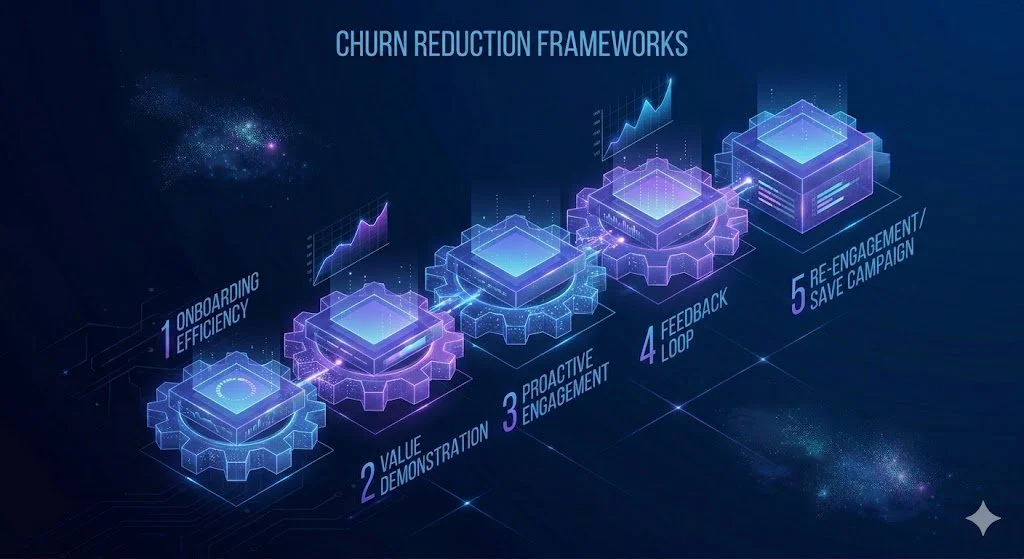
Reducing churn is one of the fastest ways a SaaS company can boost revenue without finding new customers.
Studies repeatedly show that small improvements in retention translate into outsized gains in lifetime value and profitability — for many startups, a 1–2% improvement in monthly churn is worth more than large spikes in acquisition.
That's why churn reduction frameworks matter: they turn ad-hoc retention efforts into repeatable, measurable systems that scale with the business.
Why Churn Reduction Frameworks Matter
Founders often obsess over acquisition — and for good reason — but retention decides whether growth sticks. Churn isn't just a number; it's a signal that the product, pricing, onboarding, or support isn't delivering sustainable value. A well-designed churn reduction framework gives teams a structured way to diagnose loss, prioritize fixes, and measure impact.
Common benefits of a formal churn reduction framework include:
- Predictable improvements in customer lifetime value and recurring revenue
- Faster identification of at-risk customers using behavioral signals rather than guesses
- Prioritization of the highest-leverage changes across product, pricing, and customer success
- Clear accountability and playbooks so teams act quickly and consistently
Core Concepts and Metrics Every Framework Uses
Before building or choosing a framework, teams should align on the metrics and definitions they'll use. Ambiguity here creates noise and slows action.
Key Definitions
- Churn Rate: The percentage of customers (or revenue) lost during a period. Distinguish between logo churn (customers) and revenue churn (MRR/ARR).
- Net Revenue Retention (NRR): Measures how much revenue is retained after expansions, contractions, and churn.
- Gross Revenue Retention (GRR): Revenue retained excluding expansion — useful for measuring pure retention health.
- Time to Value (TTV): How long a customer takes to achieve meaningful outcomes with the product.
- Churn Propensity Score: A model-derived score estimating the likelihood a customer will churn.
Leading vs Lagging Indicators
Churn itself is a lagging indicator — it happens after users have disengaged. Effective frameworks focus on leading indicators that give teams time to act:
- Feature adoption and active usage
- Frequency of key actions (logins, workflows completed)
- Engagement with onboarding and support resources
- Product health signals (error rates, integrations status)
- Customer sentiment (NPS, CSAT comments)
Five Churn Reduction Framework Patterns
Not every company needs a reinvented framework. Many high-performing teams combine modular patterns depending on maturity, user base complexity, and resources. Here are five proven patterns used across SaaS.
1. The Data-Driven Churn Framework
This framework centers predictive analytics and automated interventions. It uses historical data to score accounts on churn risk and triggers personalized outreach for high-risk segments.
- Components: feature usage metrics, engagement cohorts, churn propensity model, playbooks integrated with CRM.
- Pros: scalable and proactive. Cons: needs data maturity and instrumentation.
2. The Customer Success Playbook Framework
Focused on human-led retention, this framework maps lifecycle stages to repeatable playbooks for onboarding, expansion, renewals, and recovery.
- Components: health score, onboarding milestones, success plan templates, renewal cadence.
- Pros: high touch and relationship-driven. Cons: resource intensive for many customers.
3. The Product-Led Retention Framework
For self-service and product-first companies, retention is driven by in-product experiences: clear TTV, contextual help, and retention hooks that encourage recurring value.
- Components: guided onboarding, in-product messaging, usage-based triggers, friction reduction.
- Pros: scalable and often lower cost. Cons: requires excellent product UX and analytics.
4. The Lifecycle Segmentation Framework
Segmenting customers by persona, ARR tier, or use case and applying tailored tactics for each segment produces better ROI than one-size-fits-all plays.
- Components: persona mapping, tiered playbooks, custom KPIs per segment.
- Pros: targetted, efficient. Cons: requires clarity on segmentation logic and effective routing.
5. The Pricing & Contract Framework
Retention is highly sensitive to pricing structure and contract terms. This framework focuses on aligning pricing to customer outcomes and using contract mechanics (annual billing, incentives) to reduce churn.
- Components: ideal customer profiles per plan, annual vs monthly analysis, upgrade/downgrade rules.
- Pros: directly impacts revenue retention. Cons: pricing changes carry churn risk if handled poorly.
Building a Churn Reduction Framework: Step-by-Step
Creating a framework is less about choosing a template and more about executing a repeatable process. Here's a practical roadmap that a SaaS founder or head of growth can follow.
Step 1 — Audit and Baseline
Start with a data and process audit:
- Define churn metrics (logo vs revenue, monthly vs annual)
- Collect baseline numbers for the past 12–24 months
- Inventory instrumentation: product events, CRM fields, billing events
- Map out current retention touchpoints and playbooks
Founders often discover mismatches in definitions (e.g., counting cancellations vs non-renewals). Fix those first — consistent metrics are the foundation of any framework.
Step 2 — Segment and Identify High-Leverage Groups
Not all churn is equal. Segment customers by ARR tier, product usage patterns, industry, and contract length. Ask: which segments cause the largest revenue leaks? Where does churn spike (onboarding, month 6, post-upgrade)?
Step 3 — Define Leading Indicators and Health Signals
Create a health score model using a small number of strong predictors. Typical components:
- Time since last meaningful action
- Completion of onboarding milestones
- Frequency of core product actions
- Customer support ticket volume or sentiment
- Billing anomalies
Keep it simple at first — it's better to have a usable health score than an overly complex one that nobody trusts.
Step 4 — Design Playbooks for Each Risk Level
For each segment and risk tier, create concrete plays. Example plays:
- Low risk: automated newsletters, product update messages
- Medium risk: in-app coach, targeted content, outreach from CS reps
- High risk: account review call, action plan, service credits or incentives
Document scripts, success criteria, and escalation paths. Make sure CRM or engagement tools automate routing so the right person acts at the right time.
Step 5 — Build Predictive Models (if possible)
When data is sufficient, build churn propensity models. Useful modeling options:
- Logistic regression for interpretable baseline models
- Gradient boosting (XGBoost, LightGBM) for accuracy with tabular data
- Survival analysis to model time-to-churn explicitly
Prioritize features that reflect engagement, value realization, and friction. Validate models with holdout sets and measure calibration — a churn score should correlate with real risk. If you want to explore automation and feature suggestions for model-driven workflows, consider tools that generate or integrate predictive models and SaaS services into your stack.
Step 6 — Automate and Integrate
Link models and health scores to operational systems. Examples:
- Push high-risk flags to CRM (Salesforce, HubSpot)
- Trigger in-product messages via Pendo, Appcues, or Intercom
- Create renewal reports in the BI stack (Looker, Metabase) for CFO and RevOps
Step 7 — Run Experiments and Iterate
Test interventions: A/B test onboarding flows, messaging, and pricing tweaks. Track not just short-term engagement but longer-term retention. Keep a learning log and retire plays that don't move the needle.
Practical Tactics That Reduce Churn
Frameworks are helpful, but founders need tactics they can implement in weeks, not months. Here are targeted actions with high ROI.
Improve Onboarding and Time to Value
- Use goal-oriented onboarding: ask customers what success looks like and map milestones to deliver it.
- Introduce an "aha moment" checklist and reduce steps to reach it.
- Offer live onboarding sessions for high-value accounts.
Use Behavioral Triggers
- Trigger outreach when key actions stop happening (e.g., no logins after 7 days).
- Send contextual tips when users hit friction points in workflows.
Proactively Manage Renewals
- Start renewal conversations months in advance for annual contracts.
- Use NRR-focused playbooks to secure expansions before renewal dates.
Make Support a Retention Channel
- Respond fast to P1 issues and loop CS in for recurring problems.
- Turn support interactions into growth opportunities by logging product gaps and prioritizing fixes.
Align Pricing to Outcomes
- Offer annual billing discounts and product bundles tied to outcomes.
- Reduce churn risk by aligning price with realized value (usage-based or tiered around core workflows).
Tools and Tech Stack Recommendations
Choosing tooling should match stage and complexity. Here’s a practical stack map spanning early-stage to scale:
- Product Analytics: Mixpanel, Amplitude — for event-based tracking and funnels
- In-Product Messaging: Intercom, Pendo, Appcues — for contextual nudges
- CRM & CS: HubSpot or Salesforce plus Gainsight or ChurnZero for enterprise playbooks
- BI & Warehouse: BigQuery/Snowflake + Looker/Metabase for retention dashboards
- Data Layer: Segment or RudderStack for consistent event delivery
Start lean: instrument a few critical events first, then expand as hypotheses require more signals.
Example: How a Startup Used a Churn Reduction Framework
Consider a hypothetical SaaS startup, "Syncly," which offers workflow automation to small marketing teams. Syncly had 6% monthly logo churn and a freemium model. CKI Inc worked with Syncly to implement a churn reduction framework with these key moves:
- Audit: Found churn concentrated in freemium-to-paid trials during weeks 2–4.
- Segmentation: Prioritized mid-sized teams (10–50 users) on monthly plans as highest revenue risk.
- Onboarding overhaul: Reduced TTV by adding an integration wizard and free 30-minute setup calls for mid-tier signups.
- Health score & triggers: Built a simple three-factor health score (activity, integrations connected, onboarding completion) and alerted CS for accounts dropping below threshold.
- Experimentation: A/B tested an annual plan with an onboarding bonus vs. a standard annual discount.
Within six months, Syncly reduced monthly churn from 6% to 3.8% and increased NRR by 12%. The combination of narrower segmentation, faster TTV, and automated intervention created a repeatable retention engine.
Governance, Teaming, and KPIs
Frameworks succeed when owners and cadence are clear.
- Appoint a retention owner — often Head of Customer Success or VP Growth — responsible for the health score and playbook execution.
- Set monthly retention KPIs (e.g., target MRR churn, activation rate improvements).
- Run a weekly retention standup to review at-risk segments, experiment status, and outstanding product bugs impacting retention.
- Embed retention goals in OKRs for product, CS, and marketing so incentives align.
Common Pitfalls and How to Avoid Them
Even good frameworks fail when teams fall into common traps. Here are pitfalls observed across many startups and practical ways to avoid them.
Pitfall: Over-Instrumentation Without Action
Collecting data without operationalizing it wastes resources. Fix it by prioritizing 3–5 action-oriented signals and building automation that routes them to people who can act.
Pitfall: One-Size-Fits-All Playbooks
Playbooks that ignore segmentation often waste CS bandwidth. Use persona and ARR-tier logic to tailor actions.
Pitfall: Late Intervention
Churn prevention must be proactive. Model leading indicators and move from quarterly renewal firefighting to weekly health monitoring.
Pitfall: Overreliance on Discounts
Discounts can temporarily reduce churn but often mask deeper issues. Offer incentives sparingly and focus first on value delivery and TTV.
Quick Churn Reduction Checklist
- Define churn metrics: logo vs revenue, monthly vs annual.
- Instrument 10–15 product events aligned to value discovery.
- Segment customers by ARR, persona, and use case.
- Build a simple health score with clear thresholds.
- Create playbooks for low, medium, and high risk.
- Integrate triggers into CRM and in-product messaging.
- Run A/B tests for onboarding and renewal tactics.
- Monitor NRR and GRR monthly and iterate.
How CKI Inc Helps Founders Build Churn Reduction Frameworks
CKI Inc specializes in helping SaaS founders at both the launching and scaling stages. For startups in the incubator, CKI helps prioritize early instrumentation, establish onboarding flows that minimize TTV, and choose the right retention levers for an MVP. For scaling SaaS businesses, CKI’s growth services build data-driven churn reduction frameworks, integrating predictive models, customer success playbooks, and pricing strategies aligned to long-term retention.
CKI’s approach emphasizes practicality: start with the smallest viable framework that drives measurable retention improvement, then expand with automation and analytics as the business grows. That means fewer meetings and more playbooks that actually get used. If you’re planning a product or product launch, CKI also supports founders who are launching SaaS startups and need hands-on help executing retention-first workflows.
Measuring Success: What “Good” Looks Like
Success depends on stage and price point, but common benchmarks help set expectations:
- Early-stage B2B SaaS (self-service): monthly churn under 5% is promising; aim to drop to 2–3% as the product matures.
- Mid-market SaaS: aim for NRR > 100% and GRR > 90%.
- Enterprise SaaS: net retention above 110–120% is common among category leaders.
Look beyond headline churn rates: track cohort retention over 12–24 months, monitor expansion revenue, and track TTV improvements. The combination of fewer cancellations and more expansions is the healthiest signal.
Final Thoughts
Churn reduction frameworks aren't one-off projects; they're the operating system that keeps growth durable. Whether a founder needs simple playbooks for an early-stage product or a full-fledged predictive retention engine for a scale-up, the smartest approach is iterative: instrument what matters, automate the obvious, and let human expertise handle the nuanced cases.
For SaaS founders, particularly those working with CKI Inc through its incubator or growth services, the path is clear: start with the smallest framework that can materially reduce churn, measure relentlessly, and expand the system with the next highest-leverage improvements. That way, every retention win compounds into long-term value.
Frequently Asked Questions
What exactly is a churn reduction framework?
A churn reduction framework is a repeatable system combining metrics, data signals, playbooks, tooling, and governance that helps a SaaS company predict, prevent, and recover customers at risk of leaving. It’s designed to be operational — not theoretical — so teams can consistently act on retention signals.
How soon can a startup expect to see results?
Small, tactical changes (like improved onboarding or automated touches at key moments) can show impact within 30–90 days. Larger efforts (predictive models, pricing changes) typically take 3–6 months to implement and measure on cohorts. The key is running short, measurable experiments.
Should a company use discounts to reduce churn?
Discounts can stop an imminent cancellation, but they’re often a blunt instrument that masks underlying product or service problems. They’re best used selectively as part of a win-back or renewal negotiation, alongside fixes that increase actual value delivery.
Which teams should own retention work?
Retention is cross-functional: product, customer success, marketing, and finance all play roles. A single retention owner — often Head of Customer Success or VP Growth — should coordinate the framework and own the health score and playbook execution.
How does pricing affect churn, and what should founders consider?
Pricing affects perceived value and commitment. Annual contracts typically reduce churn vs monthly. Usage-based pricing can align cost to value but needs careful thresholds to avoid surprise bills. Founders should test pricing changes with clear hypotheses and measure impact on both churn and expansion.
Get A Free 30-Minute Strategy Session
Fill out the questionnaire to receive a personalized growth plan based on your current stage, from startup to enterprise, through a free consulting session with one of our executives.
Get Started ➜Related Articles







Product-Led Growth isn't just a strategy for acquisition; it is the fundamental engine for lifecycle expansion. Founders who obsess over PLG beyond the initial sale understand a critical truth: your product itself must create and capture new value.