

Meeting SaaS Customer Expectations: A Full Guide for Startups
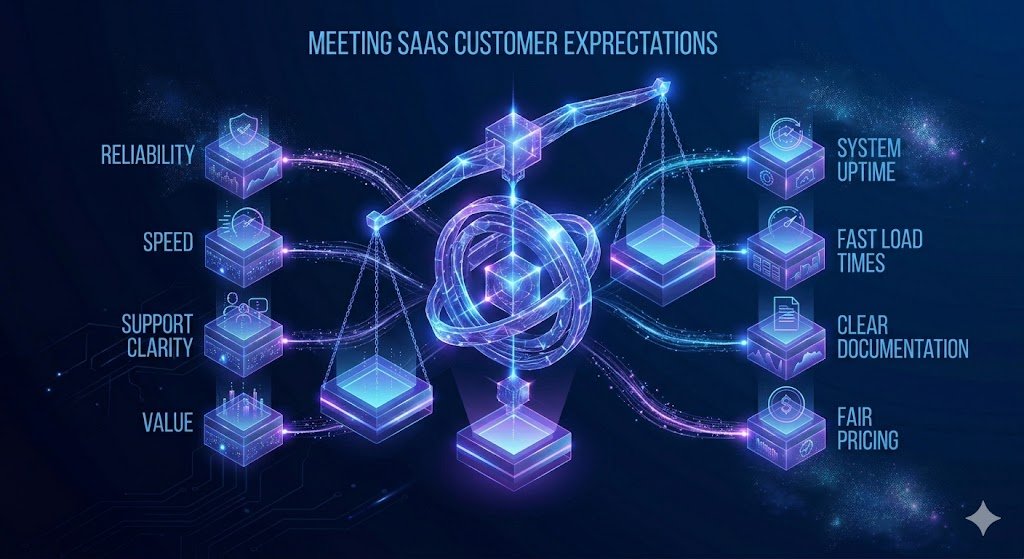
A fast-growing SaaS startup discovered that new users were signing up enthusiastically but often disappeared after two weeks.
The onboarding checklist was long, the product felt complicated, and support replies took days. Fixing those gaps cut churn in half within three months.
That kind of turnaround comes from understanding and meeting core saas customer expectations—not guessing at what customers want, but building systems that reliably deliver value.
Why SaaS Customer Expectations Matter More Than Ever
SaaS companies live or die by retention. For subscription businesses, acquiring customers is expensive; keeping them is where profitability—and predictable growth—happens. Founders who nail saas customer expectations shorten the path to value, reduce churn, increase lifetime value, and turn users into advocates. For startups and scaling businesses alike, meeting expectations is both a product and an operations challenge: it touches UX, onboarding, support, pricing, compliance, and the company’s culture.
What Customers Expect From Modern SaaS
Customer expectations keep evolving. But across industries and company sizes, a reliable set of needs emerges. Below is a practical breakdown of what customers expect and how founders can design for those expectations.
1. Fast Time-to-Value (TTV)
Users sign up because they want a problem solved quickly. If value isn't obvious within days—or preferably minutes—they churn.
- What this looks like: A clear value proposition on the landing page, a short onboarding checklist, and first-use wins within one session.
- How to deliver: Implement an activation funnel that measures time-to-first-key-action. Use guided product tours, pre-filled demo data, and templates for common use cases.
- Metrics: Activation rate, median TTV, time to first key event (e.g., first report generated, first email sent).
2. Seamless, Personalized Onboarding
Onboarding isn’t one-size-fits-all. Customers expect a tailored experience that respects their context—company size, role, and use case.
- Practical steps: Segment users early (self-serve vs. enterprise), offer role-based tours, and provide targeted in-app tips. For high-value customers, route to a Customer Success Manager (CSM).
- Automation: Use event-driven email sequences and in-app messages triggered by user behavior.
3. Reliable Performance and Availability
Downtime and slow performance erode trust quickly. Customers expect the product to be available, fast, and consistent.
- Investments that matter: Monitoring, alerting, SLAs for paying customers, and a transparent incident communication plan.
- Transparency: Public status pages and honest incident postmortems build credibility.
4. Responsive, Multi-Channel Support
Customers want help when they need it—and through the channel they prefer: chat, email, phone, or self-serve docs.
- Best practices: Offer live chat for urgent issues, strong knowledge base content, and tiered support with faster SLAs for paid plans.
- Proactive outreach: Automated alerts that prompt CSMs to contact customers showing signs of friction can avert churn.
5. Clear, Fair Pricing and Billing
Complex or unexpected billing is a top complaint. Customers expect transparent pricing aligned with the value they receive.
- Guidance: Publish pricing clearly, show how features map to plans, and provide usage dashboards so customers can forecast costs.
- Flexibility: Offer trial periods, usage-based tiers, and easy upgrade/downgrade flows.
6. Security, Privacy, and Compliance
Enterprise and regulated customers especially demand strong security and compliance posture—encryption, role-based access, SOC 2, GDPR, CCPA, etc.
- What to do: Build basic controls early, make privacy docs accessible, and invest in compliance certifications as you scale.
- Communication: Provide clear data processing agreements and a security page that lists controls and certifications.
7. Integrations and Extensibility
Customers don't want silos. They expect the SaaS product to play nicely with their existing stack through APIs, integrations, and native connectors.
- Prioritization: Add integrations that reduce friction for onboarding and common workflows.
- Developer friendliness: Publish API docs, SDKs, and sandbox environments for technical customers.
8. A Clear Product Roadmap and Regular Communication
Customers value transparency. They want to know that the product is evolving in ways that align with their needs.
- Approach: Publish a product roadmap or a changelog, solicit customer feedback, and highlight customer-driven features.
- Results: Customers who feel heard are more likely to renew and recommend the product.
9. Data Portability and Ownership
Users expect they can export their data easily and migrate if needed. Lock-in from poor data export options fosters distrust.
- Implementation: Provide easy export tools, clear data retention policies, and migration guides.
10. Community and Self-Service Resources
A thriving user community, comprehensive docs, and templates empower customers and reduce support load.
- Community channels: Forums, Slack/Discord groups, and customer advisory boards help surface product insights and advocacy.
How Founders Should Translate Expectations Into Product and Operations
Understanding expectations is one thing—operationalizing them is another. The following playbook outlines concrete actions founders can use to align product, marketing, and customer success.
Step 1 — Map the Customer Journey
Create a detailed journey map that captures acquisition, activation, adoption, expansion, and renewal. Identify moments of friction and define the desired outcome for each stage.
- List key user personas and use cases.
- Define the activation metric for each persona (e.g., first project created, first report shared).
- Build experiments to reduce time-to-activation.
Step 2 — Instrument Everything
Without data, assumptions rule. Instrument product events, funnels, and support touchpoints so the team can measure where expectations are unmet.
- Tools: Analytics (Mixpanel/Amplitude), product analytics, CRM, and support platforms.
- Important events: Signup, onboarding steps, feature usage, support requests, payment failures, and churn triggers.
Step 3 — Build a Proactive Customer Success Function
Customer Success isn't just for enterprise deals. A proactive CSM program prevents churn and drives expansion.
- Define success plans for high-value customers.
- Use health scores to prioritize outreach (usage, NPS, support tickets, product gaps).
- Run regular QBRs (quarterly business reviews) with strategic accounts.
Step 4 — Adopt a Test-and-Learn Mindset for Pricing
Pricing should reflect value, and value changes over time. Test different models—tiered, per-seat, usage-based—and measure impact on conversion and retention.
- Run A/B tests on plan features and price points.
- Use packaging to guide users to higher-value plans (feature anchoring).
Step 5 — Invest in Onboarding and Self-Serve Support
Even small teams can produce outsized results here: concise docs, helpful videos, and smart in-app guidance reduce support load and increase satisfaction.
- Measure content effectiveness via help-center analytics.
- Prioritize guides that prevent repetitive support tickets.
Step 6 — Communicate Regularly and Honestly
Set customer expectations by communicating roadmap priorities, incident updates, and feature timelines. Consistent, honest communication builds trust even when things go wrong.
Key Metrics That Reflect Whether Expectations Are Being Met
Tracking the right KPIs helps teams focus on outcomes customers care about.
- Churn Rate: Monthly and annual churn for accounts and revenue.
- Net Revenue Retention (NRR): Measures renewal and expansion; critical for SaaS growth.
- Time-to-Value (TTV): Median time between signup and first meaningful outcome.
- Activation Rate: Percentage of users who hit the defined activation event.
- NPS/CSAT/CES: Direct signals of customer sentiment and friction.
- Support Metrics: First response time, average handle time, ticket volume, and resolution rate.
Practical Examples and Playbooks
Below are a few concrete, replicable playbooks that a startup can adopt immediately.
Onboarding Playbook for a Self-Serve SaaS
- At signup: show a one-step setup with a "start tour" and "skip" option.
- Within 10 minutes: present a checklist that guides the user to the activation event.
- 24 hours after signup: send an email with onboarding tips and links to docs tailored to the chosen persona.
- Day 3: trigger an in-app nudge if key steps aren't completed; offer live chat support.
- Week 1: ask a short CSAT question about onboarding and route low scores to an outreach queue.
Enterprise Expansion Playbook
- After initial adoption: schedule a CSM kickoff within 2 weeks.
- Month 1: map use cases and set a 90-day success plan.
- Month 3: run a value review showing ROI and propose tailored expansion paths (additional modules, seats).
- Ongoing: quarterly business reviews and documented outcomes help justify renewals and upsell.
Support Efficiency Playbook
- Tier 1: self-serve docs and bots for basic issues.
- Tier 2: human chat/phone for configuration and workflows.
- Tier 3: engineering escalation for bugs and complex integrations.
Common Pitfalls and How to Avoid Them
Founders often trip over assumptions, under-investing in customer-facing systems or overfocusing on acquisition. Here are the frequent pitfalls and fixes.
Pitfall: Treating Onboarding Like a Checklist
Fix: Design onboarding around user outcomes. Remove optional friction until the user sees value.
Pitfall: Reactive Support Only
Fix: Build preventive signals—health scores and usage alerts—and reach out before users become disillusioned.
Pitfall: Hiding Pricing Complexity
Fix: Make pricing predictable and explain cost drivers. Offer cost calculators for usage-based models.
Pitfall: Ignoring Small Customers
Fix: Small customers can be a massive source of growth and feedback. Invest in scalable engagement like community forums and robust docs.
How CKI Inc Helps Founders Meet SaaS Customer Expectations
CKI Inc works with two types of clients: scaling SaaS businesses and SaaS startups in the incubator. For scaling companies, CKI emphasizes customer success to reduce churn and increase retention—helping teams implement the playbooks described above, build effective CSM programs, and operationalize signals that predict churn. For startups in the incubator, CKI focuses on establishing product-market fit quickly, designing onboarding flows that deliver immediate value, and creating go-to-market strategies that align pricing to perceived value.
Examples of the support CKI provides include:
- Designing activation funnels and TTV experiments to increase conversion and reduce early churn.
- Building customer success playbooks with realistic KPIs and scalable outreach models.
- Advising on pricing tests and packaging to improve NRR and expansion rates.
- Helping startups choose integrations that accelerate onboarding and adoption.
These services are practical and tactical—aimed at rapidly closing gaps between what customers expect and what the product delivers.
Roadmap Checklist: What to Prioritize in Months 0–12
A founder’s first year sets the foundation for long-term retention. Here's a prioritized checklist for the first 12 months.
- Month 0–2: Define activation metrics and instrument signups, core events, and funnels.
- Month 2–4: Launch initial onboarding improvements and create essential docs and templates.
- Month 4–6: Implement basic health scoring and customer segmentation; start proactive outreach for high-value segments.
- Month 6–9: Add integrations that unblock typical customer workflows; publish a public status page and basic security docs.
- Month 9–12: Formalize pricing tests, develop a community channel, and begin collecting structured feedback for roadmap decisions.
Measuring Success: What Good Looks Like
Benchmarks vary by market and price point, but founders can use these rough targets as a north star:
- Activation Rate: 40–60% for self-serve products (higher is better for niche tools).
- Monthly Churn: Below 3% for early-stage B2B; below 1% for mature enterprise-centric businesses.
- Net Revenue Retention: >100% is ideal—this means expansion covers churn and more.
- NPS: 30+ is healthy for B2B SaaS; 50+ is excellent.
Scaling Expectations With Growth
As a SaaS grows, customer expectations scale too. Enterprise customers demand SLAs, advanced security, and dedicated support. Founders must plan organizational changes alongside product ones: hire specialized support, senior CSMs, and security personnel, and move from ad-hoc processes to repeatable ones. The investments that reduce churn for early customers—clear onboarding, transparent pricing, strong docs—remain valuable at scale. They just need to be institutionalized.
Final Tips From Practitioners
- Start small and test: Pick one major friction point and run an experiment. Small wins compound quickly.
- Make feedback low-effort: Ask one question at the right time (e.g., after a key milestone), then act on the responses.
- Share wins internally: When a change reduces churn or improves activation, celebrate and document the process.
- Build a customer obsession habit: Weekly rituals—support roundups, product-squad customer calls, and NPS reviews—keep the focus on expectations.
Frequently Asked Questions
What are the top three saas customer expectations founders should focus on first?
Focus on time-to-value, reliable support, and transparent pricing. These three areas most directly affect early activation and churn and are relatively actionable even with small teams.
How can a startup measure time-to-value effectively?
Define a clear activation event that represents meaningful value (not just account creation). Then measure the median time from signup to that event. Track cohorts and changes after onboarding improvements to see impact.
Is customer success necessary for self-serve SaaS?
Yes. Even self-serve products benefit from a lightweight customer success function—automation, onboarding content, and occasional human outreach for high-value customers make a huge difference in retention.
How does pricing influence customer expectations?
Pricing sets expectations about level of service and features. Higher price implies better support, faster SLAs, and more advanced security. Align plan benefits and support level with price to avoid mismatched expectations.
What should startups include on a security page to reassure customers?
List encryption in transit and at rest, authentication options (SSO, 2FA), basic access controls, incident response practices, and any certifications or compliance efforts. A clear contact for security inquiries helps, too.
Conclusion
Meeting saas customer expectations is a continual process—one that requires empathy, data, and disciplined execution. For founders aiming to launch or scale a SaaS product, the most reliable path to growth is reducing friction between sign-up and meaningful value, backing the product with responsive support, and pricing transparently. Small, focused experiments around onboarding, support, and pricing pay off quickly.
CKI Inc helps startups and scaling SaaS teams do exactly this: build repeatable playbooks for onboarding and customer success, design pricing experiments that reflect value, and create the operational disciplines that keep customers satisfied. Founders who treat customer expectations as a product problem—one that can be measured and iterated on—are the ones who scale sustainably.
Start with one high-impact metric, instrument it well, and iterate. Customers will notice—and stay.
Get A Free 30-Minute Strategy Session
Fill out the questionnaire to receive a personalized growth plan based on your current stage, from startup to enterprise, through a free consulting session with one of our executives.
Get Started ➜Related Articles

7 Extremely powerful & free marketing tools: designed to grow your business, fast. Uncover the secrets of leveraging powerful free resources for maximum advertising and customer reach.