

Improving Software Customer Retention: Practical Strategies for SaaS Growth
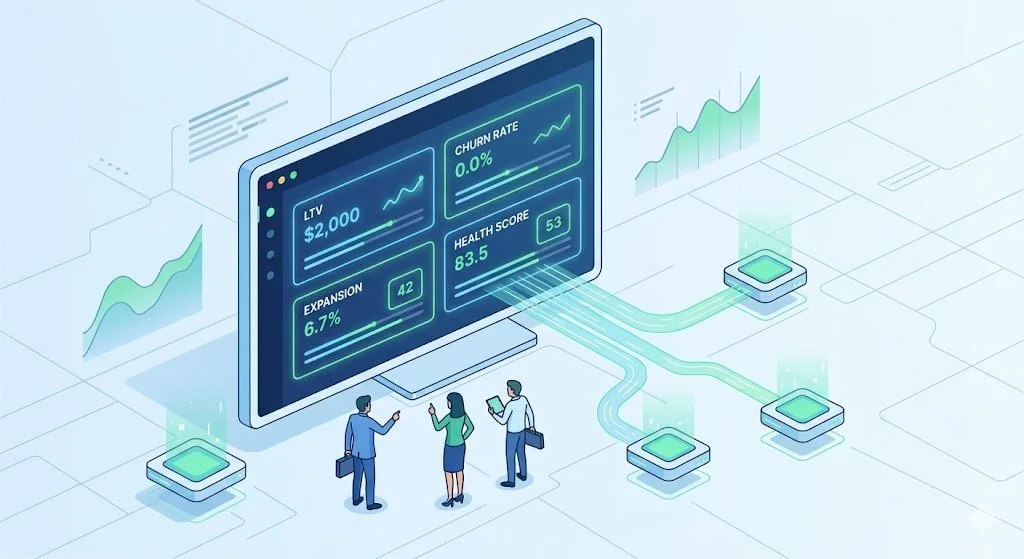
Improving software customer retention is the fastest, most predictable lever a SaaS business can pull to boost profitability and scale sustainably.
For many SaaS startups, even a small bump in retention—say 5%—can translate into a disproportionate lift in lifetime value (LTV) and overall margin.
That makes retention a strategic priority for founders and growth teams who want to get the most out of every acquired customer.
Why Customer Retention Deserves a Central Role
Retention matters because it touches every financial and operational metric that defines a healthy SaaS company. When customers stay longer, LTV rises, CAC payback shortens, churn-driven volatility drops, referrals increase, and the company can reinvest more confidently in product, sales, and marketing.
- Lower CAC per lifetime customer: The longer a customer stays, the more revenue each acquisition dollar yields.
- Predictable revenue: High retention smooths ARR growth and makes forecasting reliable.
- Higher valuation multiples: Investors prize recurring streams and stable churn when assessing SaaS valuations.
- Better product-market fit signals: Retention is a leading indicator of whether a product solves a real problem.
For founders launching or scaling a SaaS product, improving software customer retention isn’t a nicety—it's the organizational north star.
Common Causes of Churn (And How To Spot Them)
Churn rarely comes from a single cause. It’s usually the end result of multiple small failures across onboarding, product experience, pricing, support, and communication. Identifying the root causes is the first step toward durable improvement.
- Poor initial activation: Customers never reach the "aha" moment. Low activation rates often predict high churn.
- Feature mismatch: The product lacks capabilities the customer needs or includes distracting complexity.
- Poor onboarding: Setup is confusing, integrations fail, or the first value take too long to materialize.
- Bad support experience: Slow replies, unresolved tickets, or tone-deaf help frustrate users.
- Price/value mismatch: Customers feel they pay too much compared to the perceived benefit.
- Organizational changes: Vendor consolidation, shifting budget priorities, or role turnover at customers.
To address churn, teams need diagnostic clarity: which of these problems (or which combination) causes most departures in a given cohort?
A Framework for Improving Software Customer Retention
Retention work should be systematic. A simple, proven framework helps teams prioritize and execute:
- Measure: Establish the right metrics and segment cohorts.
- Diagnose: Use qualitative and quantitative signals to find root causes.
- Experiment: Run focused tests—onboarding flows, pricing, support SLAs.
- Scale what works: Bake winning interventions into processes and product.
- Institutionalize learning: Create playbooks, success plans, and cross-functional rituals that sustain retention gains.
Each step requires people, tools, and discipline. Founders who treat retention as an engineering problem—one that’s observable, testable, and optimizable—move faster.
Measure: Metrics That Reveal Retention Health
Not all retention metrics are equal. Here’s what matters most and how to track it.
Core Metrics
- Monthly/Annual Churn Rate: Percentage of customers lost over a period. Use both MRR churn and logo churn for a full picture.
- Net Revenue Retention (NRR): Compares current MRR from existing customers (including expansions and contractions) to MRR at the period start. A single number that captures expansion-led growth.
- Gross Revenue Retention (GRR): Measures revenue retained without expansions—useful for seeing revenue erosion.
- Customer Lifetime Value (LTV): Average revenue a customer contributes over their lifetime. Improves with retention.
- Cohort Retention Curves: Track user survival across months since acquisition rather than aggregated churn.
- Activation Rate: % of users who complete the key actions that lead to "aha."
Segmentation Is Critical
Slice metrics by product plan, acquisition channel, customer size, industry, and onboarding path. Often the headline churn number hides stark differences across cohorts. For example, self-serve users may churn at 8% monthly while enterprise customers churn at 1%—each cohort needs different retention playbooks.
Diagnose: Combining Data With Qualitative Feedback
Numbers point to problems, but conversations reveal why they happen. A balanced diagnostic combines app analytics and direct customer feedback.
- Product analytics: Use tools like Mixpanel, Amplitude, or Heap to find drop-off points in flows and feature adoption patterns.
- Session recordings & heatmaps: Tools such as FullStory or Hotjar show friction in the UI.
- Customer interviews: Talk to churned customers and sticky customers. Ask about the first days and the tipping point for renewal decisions.
- Support ticket analysis: Tag and prioritize recurring issues. High ticket volumes around a feature signal friction.
- Win/loss reviews: Conduct structured post-churn interviews with sales and the former customer to capture reasons and possible prevents.
CKI Inc advises scaling teams to run a "30-day churn rim"—a weekly ritual where product, success, and analytics review recent cancellations to identify fast wins.
Act: Onboarding and Activation Strategies
Most retention gains come from improving the early experience. If the first 7–30 days are optimized to deliver value quickly, retention follows.
Design the Onboarding Journey
- Map the ideal path to value: Document the exact actions that lead to the "aha" moment and remove steps that stall it.
- Personalized onboarding flows: Tailor in-app guides and emails based on user role, company size, or desired outcomes.
- Interactive checklists: Visible progress trackers increase momentum and completion rates.
- Quick wins first: Surface features that deliver immediate ROI even if advanced features come later.
- Time-bound success goals: Set clear expectations—e.g., "Set up your first campaign in 20 minutes."
Use a Mix of Channels
Combine in-app walkthroughs, triggered emails, success calls, and knowledge-base content. Self-serve customers often rely on product nudges and documentation, while higher-touch customers benefit from onboarding calls and customized implementation plans.
Product Experience: Build Retention Into the Product
Product-led retention means designing features that nudge customers to return and deepen usage over time.
Key Product Principles
- Make value discoverable: Use contextual onboarding, tooltips, and templates that highlight high-value features at the right time.
- Reduce cognitive load: Simplify workflows and prioritize core use cases before exposing advanced settings.
- Enable habit formation: Features that tie to daily workflows (integrations, notifications, dashboards) increase stickiness.
- Social and collaborative features: When more people in an organization use the product, churn friction rises because switching costs grow.
- Data continuity: Ensure reliable data import/export and integrations; losing data is a churn accelerator.
Founders should treat product improvements like conversion optimization: small, measurable changes with controlled experiments—A/B tests on onboarding copy, UI tweaks, or feature placement.
Customer Success and Support: Proactive Over Reactive
Customer success teams are the retention engine for scaling SaaS. Their role extends beyond reactive ticket handling to preventing churn through education, advocacy, and escalation management.
Operationalize Success
- Risk scoring: Build a lead-scoring–style model for churn risk using signals such as declining usage, unresolved tickets, or contract expiry.
- Playbooks: Create standardized responses for common churn risks—downgrades, pricing objections, onboarding stalls.
- Quarterly business reviews (QBRs): For mid-market and enterprise customers, use QBRs to align on outcomes and expansion opportunities.
- Success plans: Co-create measurable success plans with customers, listing milestones, owners, and timelines.
- Escalation protocols: Fast-track high-value customer issues with clear SLAs and executive oversight.
CKI’s approach with scaling SaaS companies centers on embedding customer success practices early—treating them not as a cost center but as a growth engine that reduces churn and drives expansions.
Pricing, Packaging, and Contract Strategy
Pricing influences retention both directly and indirectly. A misaligned model can push customers out; a thoughtful model can increase perceived value and reduce churn.
Pricing Best Practices for Retention
- Align pricing to outcomes: Charge for value delivered (active users, seats, usage tiers) rather than vanity metrics.
- Offer clear upgrade paths: Make it easy for customers to expand as they grow—transparent limits and generous trial thresholds help.
- Annual prepayments and discounts: Encourage longer commitments but avoid discounts that damage future upsell economics.
- Grace periods and retention-focused offers: Before canceling, present tailored retention offers like temporary credits, success workshops, or feature unlocks tied to renewed goals.
- Flexible contract terms: Remove friction for expansion—allow easy seat additions and metered usage.
Pricing experiments—like testing packaging changes or introducing a mid-tier—should be run with cohorts to measure their retention impact, not just conversion lift.
Engagement and Communication: Keep the Relationship Warm
Retention is a relationship game. Regular, thoughtful communication keeps the product top-of-mind and surfaces issues early.
- Drip campaigns for life stages: Onboarding, adoption, renewal—schedule tailored content for each stage.
- Behavioral triggers: Send helpful nudges when usage falls below thresholds, or celebrate milestones when activity spikes.
- Education at scale: Host webinars, office hours, and community forums that create peer learning and reduce support load.
- Voice of the customer programs: Run periodic NPS surveys, feature requests boards, and beta programs to keep customers engaged in the roadmap.
- Proactive renewal outreach: Start renewal conversations well before the expiry date—retention improves when customers are reminded of ongoing outcomes.
Product Analytics and Continuous Experimentation
Improving software customer retention is an iterative process. The companies that win are the ones that run disciplined experiments and bake successful changes into the product.
How to Run High-Impact Experiments
- Identify a single hypothesis: E.g., "Adding a progress checklist will increase 14-day retention by 8%."
- Define success metrics: Primary metric (cohort retention at 14 days) and secondary metrics (activation rate, support tickets).
- Target the right cohort: Small, well-defined user segments minimize noise.
- Run A/B tests or staged rollouts: Measure impact and safety checks.
- Iterate quickly: If a test fails, capture learnings and pivot. If it succeeds, scale and document.
Small, frequent wins compound over months. Even incremental improvements across onboarding, support, and feature discoverability compound into meaningful retention uplift.
Reducing Churn by Segment: Playbooks That Work
Different customer segments churn for different reasons. Tailored playbooks ensure retention activities are relevant and cost-effective.
Self-Serve SMBs
- Focus on quick activation, in-app help, and automated lifecycle emails.
- Keep pricing simple; use freemium or generous trials to demonstrate value.
- Automate risk detection (declining usage) and trigger re-engagement flows.
Mid-Market
- Blend automated onboarding with human check-ins during the first 30–90 days.
- Offer onboarding packages or implementation credits to reduce time-to-value.
- Use success plans and periodic QBRs to drive renewals and expansions.
Enterprise
- Dedicated CSMs, tailored integrations, and formal SLAs.
- Executive sponsorship mechanisms and renewal negotiation playbooks.
- Co-innovation initiatives to bind the vendor into the customer's roadmap.
Expanding Revenue: Upsell, Cross-Sell, and Advocacy
Retention and expansion go hand-in-hand. Customers who stay longer are prime candidates for upsells and become advocates that lower acquisition costs.
- Identify expansion signals: Increased usage, feature adoption, or seats growth are reliable expansion signals.
- Create value-based offers: Upsells should be framed as achieving bigger outcomes—e.g., advanced analytics that saves X hours per week.
- Referral programs: Reward customers for referrals with credits, feature access, or consulting time.
- Success-led expansions: Align CSMs to expansion targets rather than pure retention—when customers see growth, expansion becomes consultative.
Building a Retention-Focused Organization
Retention isn't just a product or success problem—it’s a company problem. Organizational design, incentives, and culture must align to support retention goals.
- KPIs across teams: Tie product, marketing, and sales KPIs to retention metrics (NRR, churn, activation).
- Cross-functional rituals: Weekly churn reviews, monthly experiment retros, and shared dashboards keep everyone accountable.
- Compensation and incentives: Reward expansions and retention, not just new bookings. This reduces perverse incentives that prioritize growth at the expense of churn.
- Knowledge sharing: Document playbooks, onboarding flows, and customer stories in a central knowledge base.
Example: CKI Inc’s Approach With Scaling SaaS Clients
CKI Inc works with scaling SaaS businesses to institutionalize these practices. A typical engagement starts with a 60–90 day diagnostic: cohort analysis, onboarding funnel review, and CS playbook audit. Quick experiments—like a revised welcome flow or a new success plan template—deliver measurable lifts within a quarter. CKI emphasizes building repeatable systems that the client team can run independently: automated health scoring, retention-focused OKRs, and a product roadmap prioritized for stickiness.
For early-stage startups in CKI's incubator, the focus is often on nailing activation and the first 100 customers. Those teams benefit from founder-led interviews, lightweight success playbooks, and rapid iteration on onboarding—practices that set the foundation for scale.
A 90-Day Roadmap to Start Improving Software Customer Retention
Founders often ask what they should do first. Here’s a practical 90-day plan with weekly milestones designed to produce quick wins and sustained momentum.
-
Days 1–14: Measure and Map
- Instrument core events and build cohort retention curves.
- Identify top 3 churn drivers using data and support tickets.
- Run 5 win/loss interviews (churned and retained customers).
-
Days 15–45: Quick Experiments
- Redesign onboarding checklist and test with a subset of new users.
- Launch a re-engagement email series for dormant users.
- Introduce a simple churn-risk scoring model and trigger CSM outreach.
-
Days 46–90: Scale and Institutionalize
- Automate successful onboarding changes and expand to all new users.
- Train CS team on new playbooks and document them in the knowledge base.
- Run a pricing/packaging health check and test one small change.
- Set up monthly retention review rituals and assign ownership.
Tools That Make Retention Work Easier
A modern stack helps teams move faster and make smarter decisions. Typical tool categories include:
- Product analytics: Amplitude, Mixpanel, or Heap
- Session recordings & UX: FullStory, Hotjar
- Customer success platforms: Gainsight, ChurnZero, or Catalyst for mid-market and enterprise
- Support & ticketing: Zendesk, Intercom, or Front
- Customer feedback & NPS: Delighted, Wootric
- Experimentation: Optimizely or LaunchDarkly
Tooling choices should map to company scale and resources. Early-stage teams can achieve a lot with lightweight analytics and disciplined manual reviews; larger teams benefit from automation and a dedicated CSM platform.
Practical Templates and Examples
Here are a few condensed, actionable templates that teams can adapt.
Simple Churn Risk Score Model (Signals)
- -10 points: No product login in 14 days
- -8 points: Support ticket unresolved > 7 days
- -6 points: Payment method fails or invoice overdue
- -4 points: Decline in daily active usage by 50% vs baseline
- +5 points: Expansion event (adds seat or usage)
Customers below a -10 threshold trigger an outbound play: CSM call, in-app guidance, and a one-off consultant session if needed.
Onboarding Email Sequence (First 30 Days)
- Day 0: Welcome + one-step setup to reach the product's core value
- Day 2: Checklist email highlighting next 3 steps with links
- Day 7: Feature highlight tied to common use cases (case study snippet)
- Day 14: Health-check—usage summary and offer for a quick call
- Day 28: ROI recap and next steps for expansion or deeper adoption
Measuring Success: What Good Looks Like
Retention improvements are visible across several indicators. Organizations should set realistic targets and celebrate small wins:
- NRR > 100%: The gold standard for expansion-led growth.
- Reduction in MRR churn by X%: A specific target aligned to company goals.
- Improved activation rates: e.g., a 15% lift in users reaching the "aha" moment within 14 days.
- Decrease in support repeat tickets: Signals lower friction and better onboarding.
Milestones should be realistic and tied to experiments. A single major product change might move activation significantly; many small operational improvements compound into stronger retention over time.
Common Pitfalls to Avoid
- Focusing only on acquisition: Growth teams often prioritize top-of-funnel metrics while neglecting retention. Balanced investment matters.
- Chasing vanity metrics: Monthly signups mean little if activation and retention are poor.
- Ignoring segmentation: One-size-fits-all strategies often fail across diverse customer types.
- Over-automating human touch: Automated processes scale but should not replace thoughtful human intervention for high-value accounts.
Final Thoughts
Improving software customer retention is both an art and a science. It requires rigorous measurement, empathetic customer conversations, product design that creates habit and value, and organizational systems that reward long-term customer success. For founders launching and scaling SaaS products, prioritizing retention pays off faster than almost any other single initiative. It reduces churn, increases LTV, and creates a virtuous cycle where satisfied customers become advocates and predictable revenue funds the next stage of growth.
CKI Inc helps SaaS teams embed these practices—combining hands-on growth work for scaling companies and structured playbooks for startups in its incubator. Whether they’re shaping the first 100 users or optimizing an enterprise pipeline, teams that systematically focus on retention build more resilient, higher-value businesses.
Frequently Asked Questions
What’s the single best metric to track for retention?
Net Revenue Retention (NRR) is the most powerful single metric because it captures contraction, churn, and expansion across an existing customer base. However, NRR should be paired with cohort retention curves and activation metrics to diagnose problems.
How quickly can a startup expect to see retention improvements?
Some changes—like onboarding fixes or a new welcome flow—can produce measurable improvements within 30–90 days. Larger product or pricing shifts may take several quarters. The key is running focused experiments and scaling what works.
Should early-stage startups hire CSMs immediately?
Not always. Early-stage teams can handle customer success through founder-led outreach and a lightweight playbook. As ARR and customer complexity grow, dedicated CSMs become essential to sustain retention and expansions.
How much should be invested in retention versus acquisition?
There’s no one-size-fits-all split, but as CAC rises, shifting incremental budget toward retention often yields better ROI. A practical approach is to allocate resources to both: short-term acquisition experiments and medium-term retention systems that compound over time.
Are discounts an effective retention tactic?
Discounts can work as a short-term retention lever but often compress long-term revenue and reduce expansion potential. More sustainable tactics include offering value-driven add-ons, success workshops, or targeted assistance that help customers achieve outcomes.
Improving software customer retention is an ongoing journey. By measuring carefully, diagnosing honestly, experimenting quickly, and scaling wisely, SaaS founders can turn retention from a problem into their strongest growth driver.