

7 Customer Relationship Management Strategies for Scaling SaaS
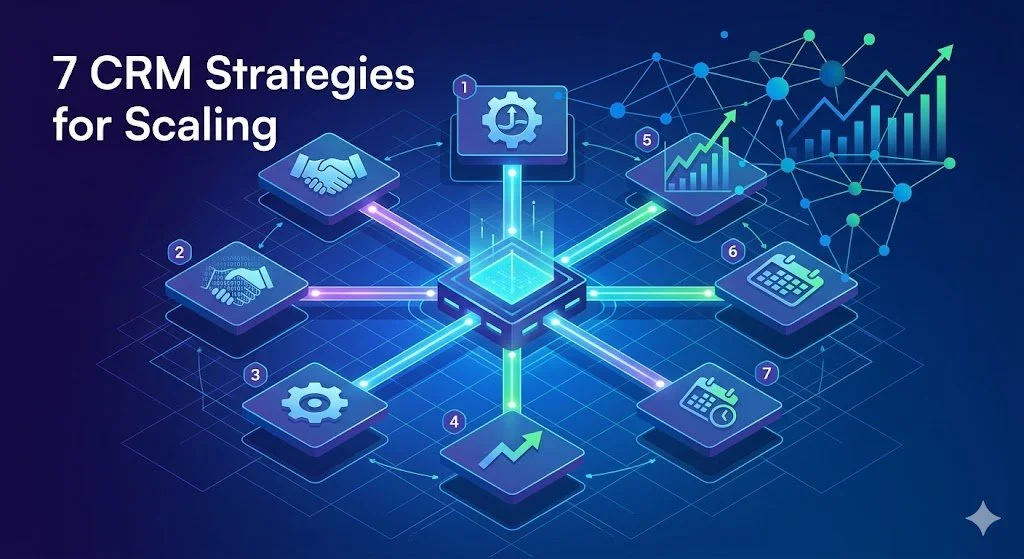
When a mid-stage SaaS company cut churn by 30% in six months, the change didn't come from a single flashy feature...
It came from adopting a handful of targeted customer relationship management strategies that aligned product behavior, support, and pricing around measurable customer value.
For SaaS founders and teams focused on sustainable growth, that shift from reactive support to strategic relationship management is the difference between steady expansion and a revolving door of customers.
Why Customer Relationship Management Strategies Matter for SaaS
SaaS businesses live and die by recurring revenue and customer lifetime value. High acquisition costs paired with poor retention quickly erode margins. That makes smart customer relationship management strategies essential: they reduce churn, increase expansion revenue, and create predictable growth. For startups and scaling companies, this turns limited resources into long-term leverage.
Key reasons these strategies matter:
- Retention drives ROI: Increasing retention by a few percentage points compounds revenue — renewals and expansions cost far less than new customer acquisition.
- Customer success fuels referrals: Satisfied customers become advocates, shortening sales cycles and improving conversion rates.
- Product-market fit evolves: Continuous feedback loops help refine the product and pricing in a way that attracts higher-value customers.
- Predictable forecasting: With solid relationship management, churn stabilizes and metrics like net revenue retention (NRR) become reliable for fundraising or planning.
Core Pillars of Effective CRM Strategies
Effective customer relationship management strategies rest on several interconnected pillars. Each pillar supports the others, and neglecting one creates weak spots where churn can creep in.
- Segmentation and customer understanding
- Onboarding and time-to-value (TTV)
- Customer success and proactive outreach
- Support and self-service
- Feedback loops and product-informed CRM
- Personalization and lifecycle marketing
- Automation and tech stack integration
- Account expansion and pricing alignment
- Measurement and continuous improvement
Segmentation and Customer Understanding
Segmentation prevents "one-size-fits-all" mistakes. Founders often treat all customers the same early on, but as the customer base diversifies, it becomes critical to segment by value, use case, company size, and growth potential. A clear segmentation model ensures the right level of service and growth strategy for each cohort.
- Segment by billing tier (freemium, SMB, mid-market, enterprise).
- Segment by usage patterns (power users vs. occasional users).
- Segment by industry or use case to tailor messaging and product roadmaps.
Practical step: create three to five primary segments and sketch ideal customer profiles (ICPs) and typical journeys for each. That becomes the blueprint for tailored onboarding, success plays, and upsell campaigns.
Onboarding and Time-to-Value
Onboarding determines whether customers see product value quickly. Reducing time-to-value (TTV) is one of the clearest levers to lower early churn — and it's often inexpensive compared to acquiring a new user.
Elements of a strong onboarding strategy:
- Create a short, measurable activation funnel: define the key action(s) that indicate initial product value.
- Use in-app guides, checklists, and milestone emails tied to those activation events.
- Offer tailored onboarding for high-value customers (dedicated CSM, custom setup sessions).
- Measure activation rates, TTV, and early churn for each segment.
Example: If activation is achieved when a user integrates with a key tool and completes a first report, automate a sequence of nudges and a product tour that guides them to those actions within the first 48 hours.
Customer Success and Proactive Outreach
Customer success is more than renewals and tickets — it’s about ensuring customers achieve measurable business outcomes. That means building proactive playbooks to spot risks and create expansion opportunities.
- Define success metrics per segment — e.g., adoption rate, number of active seats, or key workflows automated.
- Implement a health scoring model that combines usage, support activity, recent product logins, and NPS.
- Set trigger-based plays: if health score drops, reach out; if usage spikes, present expansion options.
Example health score formula (simplified):
Health Score = 0.4 * (Usage Frequency) + 0.3 * (Feature Adoption) + 0.2 * (Recent Logins) + 0.1 * (NPS)When the score falls below a threshold, a CSM or automated workflow initiates targeted outreach to diagnose friction and propose solutions.
Support and Self-Service
Fast, empathetic support reduces churn and turns frustrating moments into loyalty-building opportunities. The most scalable approach blends high-quality self-service with human support when it matters.
- Invest in knowledge bases, step-by-step guides, and searchable FAQs.
- Use in-app chat for contextual assistance and to capture intent signals.
- Define SLAs for ticket response by customer tier — enterprise customers get faster escalation paths.
- Measure CSAT and first-response times, and iterate on problematic flows.
Tip: Product walkthroughs and short how-to videos often reduce support volume while improving activation.
Feedback Loops and Product-Informed CRM
Product-informed CRM treats customer feedback as the raw material for product improvements and better CRM. The best SaaS teams close the loop: collect feedback, act on it, and communicate changes back to customers.
- Collect qualitative feedback via interviews and quantitative via NPS, CSAT, and in-app prompts.
- Migrate product requests into a prioritized roadmap visible to customers where appropriate.
- Use cohort analysis to see how features affect retention and engagement.
When customers see their feedback reflected in the roadmap, they feel heard — and retention improves.
Personalization and Lifecycle Marketing
Not all customers require the same touch. Personalization ranges from simple email segmentation to in-app adaptive flows that reflect individual usage patterns.
- Map lifecycle stages: trial, activated, engaged, at-risk, churned.
- Design campaigns for each stage: nurture for trials, tips for active users, reactivation for at-risk accounts.
- Use behavioral signals to send relevant content — e.g., feature adoption tips when usage plateaus.
Lifecycle marketing is most effective when tied to outcomes: help a customer reach the next value milestone rather than sending generic content.
Automation and Tech Stack Integration
Automation scales relationship management without removing the human touch. The challenge is selecting tools that integrate product usage and customer records so actions are timely and relevant.
Common stacks and roles:
- CRM: HubSpot, Salesforce, Pipedrive — manage contacts and deals.
- Product analytics: Amplitude, Mixpanel — track events and usage patterns.
- Customer success platforms: Gainsight, ChurnZero — health scoring and playbooks.
- Support and messaging: Intercom, Zendesk, Front — in-app and email interactions.
- Integration tools: Segment, RudderStack, Zapier — synchronize events and attributes across systems.
Advice for startups: start simple. Use a CRM with a free tier (HubSpot) and a lightweight analytics tool (Mixpanel free plan), then layer in automation as the customer base and complexity grow.
Account Expansion and Pricing Alignment
Growth doesn't come solely from attracting new logos — expansion revenue from existing customers is essential. Effective strategies align pricing, packaging, and the customer journey to enable expansion.
- Design packaging that encourages seat growth and feature add-ons rather than punishing usage.
- Create expansion playbooks triggered by usage thresholds and business milestones.
- Run pricing experiments and measure effects on churn and expansion rate.
Keep pricing transparent and tied to measurable outcomes; customers are more willing to pay when they see direct value.
Measurement and Continuous Improvement
Metrics inform decisions. A handful of clear KPIs keeps the team focused and lets founders track the impact of CRM initiatives.
- Churn Rate (monthly/annual): measure both gross and cohort churn.
- Net Revenue Retention (NRR): target >100% for sustainable growth.
- Customer Lifetime Value (CLTV) and CAC ratio: ensures unit economics are healthy.
- Time-to-Value (TTV) and activation rates: early indicators of retention.
- Product Engagement Metrics: DAU/MAU, feature adoption, session length.
- NPS and CSAT: qualitative signals for product and support quality.
Regularly review these metrics and run experiments to improve weak areas. A small, deliberate experiment every week or month compounds into big gains over time.
Practical Playbooks and Examples
Here are concrete playbooks founders can adopt quickly. They combine low-cost automation with human follow-up for high impact.
Playbook: Preventing Early Churn
- Define activation events that correlate with long-term retention.
- Trigger an in-app walkthrough and series of emails when a user signs up, timed to push them toward activation within 72 hours.
- If activation doesn't happen, create a low-friction outreach: short video walkthrough or 15-minute call with an onboarding specialist.
- Measure activation rate and early churn weekly; refine messages based on user feedback.
Playbook: Risk-Based Intervention
- Build a health score using product usage, recent logins, number of support tickets, and NPS.
- Flag accounts with declining scores and assign them to CSMs for a "diagnostic" call.
- Offer tailored solutions: refresher training, implementation assistance, or product tweaks.
- Track outcome: did the health score recover? Did churn stop?
Playbook: Expansion through Value Events
- Identify usage milestones that indicate readiness for expansion (e.g., hitting seat limits, volume thresholds).
- Automatically notify CSMs when customers approach those limits and trigger personalized outreach with relevant case studies and upgrade options.
- Offer short trials of advanced features to show immediate impact before asking for a larger commitment.
How CKI Inc. Helps Companies Put These Strategies into Practice
CKI Inc. works with both scaling SaaS companies and early-stage startups in its incubator to implement pragmatic customer relationship management strategies. For scaling teams, CKI focuses on customer success playbooks, health scoring, and aligning pricing with expansion opportunities to reduce churn and improve NRR. For startups in the incubator, CKI emphasizes rapid experiments on onboarding flows, lightweight analytics integration, and defining the first ICPs and activation metrics that will drive retention from day one.
Example approach CKI might take with a client:
- Run a week-long diagnostic to map the customer journey and identify the highest-leverage churn points.
- Design a prioritized roadmap with quick wins (e.g., improved onboarding flow, a knowledge base revamp) and medium-term investments (e.g., health scoring and CSM playbooks).
- Implement the tools and automation required, then measure and iterate on the results.
CKI’s experience with product-led and sales-assisted SaaS models helps founders choose the right balance of automation and human touch for their particular market and stage.
Common Pitfalls and How to Avoid Them
Even smart teams stumble. Here are common mistakes and practical ways to avoid them.
Over-Automation That Feels Robotic
Automating everything saves time but can alienate high-value customers. Balance automation with personalized human outreach for premium accounts and sensitive situations.
Poor Data Hygiene
Bad data yields bad decisions. Invest in consistent tagging, event naming conventions, and a single source of truth for customer records. Use a customer data platform (CDP) if data complexity warrants it.
Misaligned Sales and Customer Success
If sales promises what the product or success team can't deliver, churn follows. Align incentives and create clear handoffs so customers receive consistent messaging and expectations are met.
Ignoring Power Users
Power users often influence other buyers and uncover product use cases. Support and nurture them — they can become champions and help with onboarding new customers.
Roadmap: How to Implement CRM Strategies in 90 Days
For many startups, 90 days is a realistic window to see measurable improvements. Here's a focused roadmap founders can follow.
Days 0–30: Diagnose and Quick Wins
- Map the customer journey from signup to renewal for each segment.
- Identify the top three churn drivers and deploy one quick fix (e.g., improve onboarding flow).
- Set up basic analytics for activation and TTV tracking.
Days 31–60: Build Playbooks and Automations
- Create health scoring and two playbooks: at-risk intervention and expansion outreach.
- Implement automation for onboarding emails and in-app guides.
- Train a small CSM team or designate an owner for proactive outreach.
Days 61–90: Measure, Iterate, and Scale
- Review KPIs: activation, TTV, churn, NRR. Run experiments to improve underperforming areas.
- Refine segmentation and tailor messages for each cohort.
- Plan for next-quarter investments (support staffing, analytics upgrades, or advanced CS tooling).
Budgeting and Resourcing Recommendations
Startups should budget gradually for CRM investments. Early-stage companies can achieve meaningful gains with low-cost tools and smart processes; later-stage firms may benefit from dedicated CS platforms and hires.
- Seed-stage: prioritize free/low-cost tools (HubSpot free, Mixpanel free plan) and hire a multi-role person (growth/CS hybrid).
- Series A: invest in a basic Customer Success tool, a CSM, and a knowledge base manager. Add integration via Segment or Zapier.
- Growth-stage: formalize CSOps, adopt a CS platform (Gainsight or similar), and scale playbooks with automation.
Final Tips From Practitioners
- Measure the smallest possible thing that predicts retention (a specific activation event) — then optimize it relentlessly.
- Document playbooks and iterate them based on outcomes, not intuition.
- Run regular customer interviews; qualitative insights often reveal the root cause of churn faster than dashboards.
- Keep communication concise and value-focused. Customers respond to help that moves them closer to outcomes.
"Retention isn't a department — it's a cross-functional outcome." — Common insight among experienced SaaS operators
Conclusion
Customer relationship management strategies are the operational backbone of any successful SaaS company. By focusing on segmentation, rapid time-to-value, proactive customer success, scalable support, product-informed feedback loops, and thoughtful automation, founders can dramatically reduce churn and unlock expansion revenue. These elements work best when treated as a system: better onboarding improves health scores, which enables timely expansion outreach, which in turn improves NRR.
For founders launching or scaling SaaS products, the immediate priority is to identify the highest-leverage churn drivers and implement two to three focused plays that can be measured quickly. Over time, those plays mature into a coherent CRM engine that supports sustainable growth. Organizations like CKI Inc. help founders get there faster by combining practical playbooks with hands-on implementation support — from incubating early-stage products to scaling customer success programs that materially improve retention.
Frequently Asked Questions
What is the single most important CRM strategy for a new SaaS startup?
For most early-stage SaaS startups, the highest-leverage strategy is reducing time-to-value through a focused onboarding flow. When customers realize value quickly, activation and retention both improve. That usually beats broad marketing or complex automation early on.
How should a company measure customer health?
Customer health should combine product usage metrics (frequency, depth of feature use), engagement signals (logins, messages, ticket volume), and sentiment (NPS, CSAT). Weight these factors according to the business model and create thresholds that trigger plays for risk and expansion.
When is it time to hire a dedicated Customer Success Manager (CSM)?
Hire a CSM when accounts become complex enough to require personalized guidance (custom integrations, multi-seat deployments) or when churn threatens growth despite product improvements. A good rule: if average ACV (annual contract value) justifies the cost and hands-on work, it’s time.
What tech stack should a scaling SaaS company prioritize for CRM?
Start with a CRM (HubSpot or Salesforce depending on complexity), a product analytics tool (Mixpanel or Amplitude), and a support/chat tool (Intercom/Zendesk). Integrate these with a data pipeline (Segment or rudimentary ETL) so events and customer attributes sync across systems. Add a CS platform as complexity grows.
How does pricing interact with CRM strategies?
Pricing should encourage the behaviors that drive value (e.g., seat-based pricing for collaboration tools, usage-based models for transactional platforms). CRM strategies help identify when customers are ready to expand and ensure pricing changes are communicated as value propositions rather than cost increases.